No one likes to lose money.
Organisations certainly don't — otherwise they wouldn't focus so much on containing costs in areas such as travel. But neither do airlines.
This week IATA — the International Air Transport Association — has been holding its annual general meeting in Sydney. And financial health (as well as ill-judged comments from the CEO of a certain Middle Eastern carrier) has taken central stage on the agenda.
The top line headlines have been about expectations for profitability to drop. The airlines' member organisation announced that it expected a collective net profit of $33.8 billion in 2018. Not bad but it represents a 10% drop from the $38.4 billion that IATA forecast back in December.
Growing costs, predominantly the rising price of fuel, are being blamed. The top line explanation has focused on the rise in cost of airline fuel. The average cost of Brent crude in 2017 was $54.25 per barrel. The average price in 2018 stands currently at $68.13 per barrel, an increase of 25%.
A jump of 25% in any variable cost component of a good or service is usually a warning light that higher prices, or fares in this case, are just around the corner. However, before assuming that this is the inevitable outcome, it is worth disaggregating these top line findings, which are for all regions and classes of travel, to see what the effect might be on European travel budgets.
Our chart this week shows the figures that IATA released which examine supply and demand for passenger air transport on a regional basis:
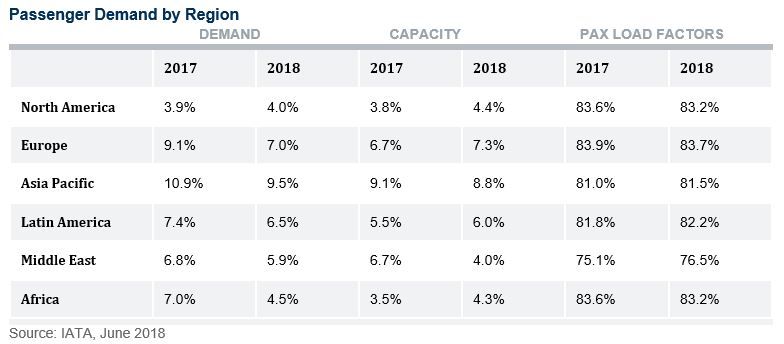
European demand, which in the world of airline metrics is revenue per kilometre (RPKs), has fallen from 9.1% to 7.0% or 23%. At the same time capacity, which is usually measured by available seat kilometres (ASKs), has risen from 6.7% to 7.3% or 9%. Passenger load factor in Europe has fallen slightly from 83.9% to 83.7% as a result.
Falling demand and increasing supply are not usually a climate for raising prices.
The IATA figures are an amalgamation of many different groups — both suppliers and buyers, business and leisure travel, traditional and low-cost carriers, economy and premium classes and that needs to be looked at more closely. The load factor required for break-even on a route where most of the passengers are budget-conscious holiday makers will be higher that what's needed on popular corporate travel routes such as London-Frankfurt where the average passenger yield is likely to be higher.
Airlines use dynamic pricing and revenue management principles for a reason. The marginal revenue generated by each additional passenger will exceed the marginal cost. IATA in fact anticipates passenger yields to grow by 3.2% this year after a decline of 0.8% in 2017.
Then there is the fuel factor. Extensive hedging by European carriers will delay the effects of a buoyant Brent crude market although North American carriers, which traditionally practise lower hedging positions, will be more immediately affected.
Yes, airlines' costs are rising but European corporate fares may not be doing so just yet.