The announcement this week that Lufthansa would start to charge an additional fee for bookings made through the GDS has brought sharp focus onto airlines' cost of distribution and sales.
In order to put these costs into perspective, we have looked at the major European airlines' financial performance in 2014 to see how these costs relate to passenger revenues.
Analysis of the figures in their annual reports show that selling costs, which typically includes agent commissions, GDS fees and advertising and promotion, amount to around 3-7% of total passenger revenue.
The full results are shown in the chart below.
Lufthansa is the only one of the major carriers to provide additional breakdown of its costs.
Continued below
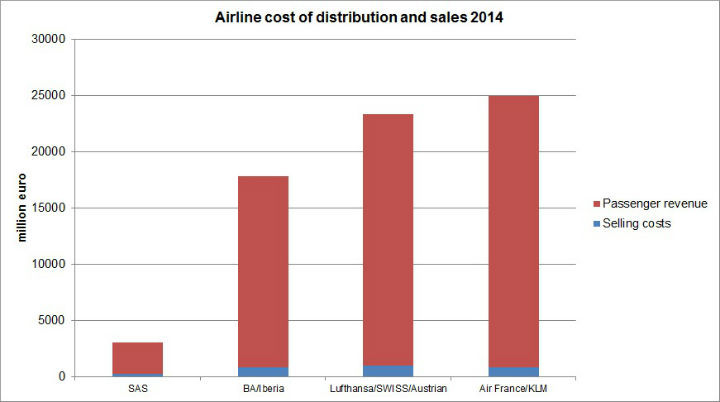
The German group reveals that around a third of its selling costs relate to commissions paid to agents (€322m in 2014), a third to distribution costs (€339m) and a third on advertising and sales promotions (€333m).
SAS says its selling and distribution costs account for around 5.9% of overall expenses, although its cost model includes jet fuel — with this stripped out the proportion is 7.8%.
In its latest annual report, the airline says, "A major review of the distribution model and marketing activities, including credit card costs and agent commissions, has been started and is expected to save hundreds of millions of kronor [tens of millions of euro].
Business travel is a small cost in relation to a company's revenue but it gets big attention because finance teams believe they are controllable. The same could be said for GDS fees.