The A380, which until recently had been showing signs of poor health, has been given a new lease of life after its biggest customer committed to buying more.
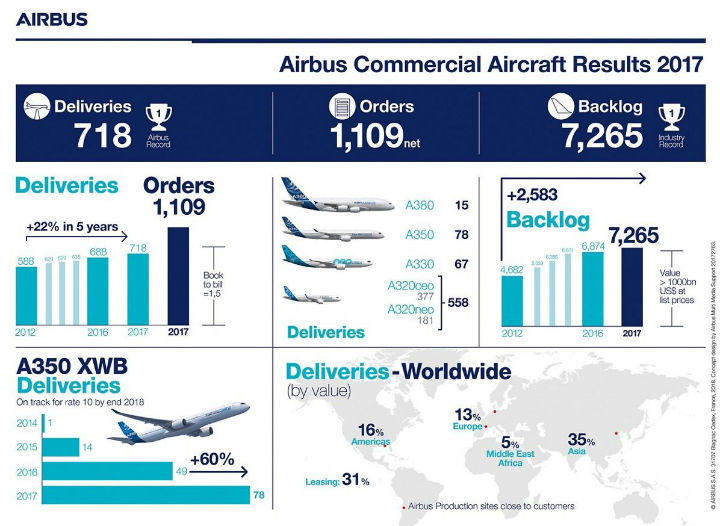
Earlier this week, manufacturer Airbus announced its figures for orders and deliveries for 2017. What made most of the headlines since it did so was speculation that the manufacturer's flagship, the A380 superjumbo, may have a shorter shelf life than the company had hoped and that production of the plane may be ended because of a slim order book.
Yet today's announcement that Emirates, which already has more than a hundred of the aircraft, would buy 36 more of the planes in a deal worth US$16 billion for delivery from 2020 is a sign that its future is assured, at least for the time being.
The aviation industry was surprised in November at the Dubai Airshow when Emirates placed an order for 40 Boeing 787-10 aircraft but made no announcement about further orders for the A380.
Reuters said at the time of the show that the Dubai government wanted guarantees that the A380 would continue production for the foreseeable future.
Emirates president Tim Clark said, "They need some copper-bottom guarantees that if we do buy some more, then the line will be continued for a minimum period of years and that they [Airbus] are fully aware of the consequences of cancellation and leaving us high and dry."
Those guarantees have clearly now been received.
John Leahy, Airbus' chief operating officer customers, Airbus Commercial Aircraft, said, "[The A380] has contributed enormously to Emirates' growth and success since 2008 and we are delighted that it will continue to do so. This new order underscores Airbus' commitment to produce the A380 at least for another ten years. I'm personally convinced more orders will follow Emirates' example and that this great aircraft will be built well into the 2030s."
The A380 first took to the skies in 2005 and entered commercial service just over ten years ago in October 2007 with Singapore Airlines.
When the A380 was first launched, there was considerable hype about how air travel would change — travellers would see in-flight shopping malls and gyms and the like; in reality, airlines have just stuffed them with seats to cut costs.
As of the end of December, Airbus had received 317 orders for the A380 of which 222 have been delivered, fewer than it would have liked. Other airlines have also been examining their use of the plane; Malaysia Airlines is axing its A380 services and replacing them with A350s, for example.
Airbus research looking at future demand shows a market of around 70 planes a year for very large aircraft with more than 450 seats.
At the same time, low-cost, long-haul services on aircraft such as the Boeing 787 appear to be doing far better than expected, particularly in the premium cabins. Norwegian recently announced that its new 787s arriving this year would have more premium seats.
The expectation that the A380 would usher in an era of cheap fares has not really materialised; airlines have instead used them to bolster their balance sheets. It's the same as it ever was.