Business travel is often spoken about with a split right down the middle; on one side, well-behaved employees and on the other, the 'rogue' travellers. This has led to much of the thinking around traveller behaviour and how best to respond to it being similarly split into these two, finite categories.
But as data and analytics have improved, it's become clear that this way of thinking has meant a loss of nuance when it comes to managing employee travel effectively. That's as true for the 21-year-old employee going to Europe for the first time as the seasoned director making their 50th trip to the Middle East. It might be Christmas soon, but the idea of a 'naughty or nice' list simply won't cut it for effective, modern business travel management.
Why the policy panic?
Of course, there are those travellers that will break away from policy and do their own thing. But despite there being any number of different issues that could lead a traveller to rebel, it usually comes down to a fundamental lack of knowledge of the behind-the-scenes benefits of staying with company policy.
Laying this out is a task that should be given some consideration in its own right. Let's face it, many internal documents that are shared within a company are 'marked as read', forgotten about and only revisited when something has gone wrong or a particular item needs checking. In many ways, a more interactive session would work best in order to explain the behind-the-scenes benefits of adhering to a travel programme, followed by an online guide that could be searched.
That is a quite an undertaking though, and may leave travel managers scratching their heads as to why they need to look so carefully at relaying policy information. But consider this: how many travellers truly understand duty of care? Or about cybersecurity and fraud risks when using company money in unapproved channels? Or the cost of suppliers and processing that it takes to chase up rogue bookings and the impact that could have on other company benefits? Do they know about how they can link personal reward accounts into their company bookings?
Once you put the benefits of your policy in front of travellers, it's going to be a tremendous amount easier to sell them on staying within policy.
As the old saying goes, you can lead a horse to water, but you can't make them drink; even with crystal clear benefits explained to employees, there are going to be different personality types to take into account. It's not as cut and dry as rogue and respectful — but categories and patterns of behaviour do begin to emerge:
The fearless traveller: These are experienced travellers that know the ropes and see travel and overseas stays as part and parcel of their working life. They've got overconfident and their behaviour, even things as innocuous as a run in the evening, could endanger them. For the fearless, the biggest area to focus on is duty of care and explaining how this needs to be implemented. Tools for locating these employees, up-to-date emergency details and clear company guidelines will be most important.
The 'I can't be bothered' traveller: Making a name for themselves on the sales floor, this traveller feels that their excellent performance means they have some leeway in how much of policy they want to follow. This can lead to issues with cost savings, duty of care and setting a bad example to their colleagues. For those that seem to fit this personality type, one way of engaging them is through gamification; use that drive that they have to ensure they remain within policy. There are some great examples of this such as Rocket Trip, whereby the traveller can get cheaper accommodation and split the cost saving between themselves and their organisation. Sometimes though, you might need to reflect costs back onto them if they still not falling in line — money talks.
The early career traveller: New to the business world, these employees will have very little experience of corporate travel and limited cashflow in order to carry it out. For them, it's a very different direction than the slightly overconfident and experienced — they need an arm around their shoulders. More of a closely managed approach to the bookings themselves will be gratefully received and a recapping of the different contacts and helplines that they can use will help set them at ease as they look to make their first trips.
The club traveller: These are the point hunters; experienced travellers that are guaranteed to hunt down as many of their loyalty rewards and free air miles as they can and stepping outside of policy to do so if needs be. There are two main ways to deal with these travellers — the carrot or the stick. Using a travel ecosystem, the ideal way to tackle their point-hunt is to enable links between their preferred suppliers and your booking capture tools, ensuring you both get what you want. If this isn't possible, the stick may come into play; blocking any bookings that are out of policy or turning the cost back on the traveller.
The 'leave this to me' traveller: For these employees, travel is a necessity, not something to be enjoyed. They don't want to spend the time creating personal preferences and signing up for loyalty schemes; they want to find the cheapest option, get it booked and not have to worry about anything else. To help them is a case of education by showing them the benefits that can come from booking through the official channels. From safety and additional time to work through booking a better-suited flight through to perks such as free lounge access, you can begin to show them that 'less is more' doesn't always ring true.
The tenured traveller: Similarly, the tenured traveller doesn't see the need for a detailed travel policy — they never had one when they were working with the company 20 years ago, so why should they now? Again, a need to showcase the benefits is important, but so too is the need educate on how the process actually works. Online tools may come easily to Generation Z entering the workplace but they are harder to pick up over time. For senior colleagues, you can work with their assistant or another member of their team that can support the process when it comes to booking.
The VIP traveller: A traveller that wants to make the most of the trip that they have — you name a perk, they will be interested in acquiring it. This will obviously lead to problems with cost and differentiation in how employees are treated during their travels. Chances are these travellers haven't explored, connected and synchronised their travel memberships across all of the services available to them. Many loyalty schemes, additional perks and customisation options can be offered through a wide, connected ecosystem by travel technology providers, meaning that companies can placate these more highly-strung travellers without having to break the bank.
The traveller matrix
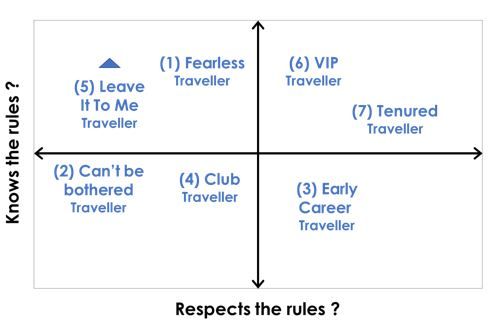
As evident from these personas, there are a lot of different types of traveller that need to be accounted for. And each of these can be plotted against two axes — how well do they know the rules and how well do they respect them. By plotting these out, it begins to form a picture of how different traveller types need to be approached.
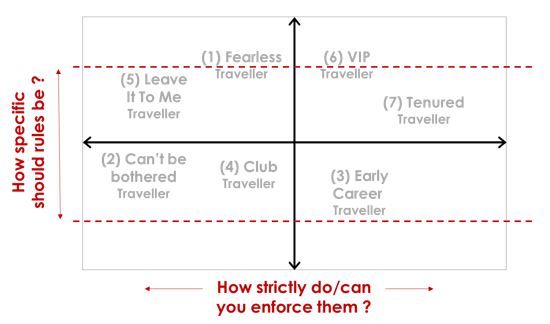
This is where the second model of the matrix comes into play. For some of these types, such as the fearless traveller, they don't need to have the rules strictly enforced but instead the information that they have should be very specific. For the early career traveller on the other hand, too much information will overwhelm them but they need to be closely enforced to keep them safe. For travel managers, these matrixes work just as well with individual names as it does with traveller categories, helping you to get that approach right.
Lean on me
There isn't a huge amount of spare time when working in travel management. The role is demanding and quite often it can lead to people feeling a little alone as they look to tackle more macro problems such as company or employee culture when it comes to travelling on behalf of work.
But remember, the best of TMCs, the best of technology providers and top-level suppliers will have similar experiences. And what separates the great from the good is their ability to speak frankly and share ideas to help under-fire travel managers. Whoever supplies your booking tool or books flights on your behalf shouldn't just give you the service or product then leave; they should be working in an advisory capacity too.
It may seem that these challenges are new, but in fact they have been around for as long as business travel has. The only difference nowadays is that the tools and the data available to help those running travel programmes has improved. Using this technology and others experience of what travellers want, travel managers can ensure that all their travellers are satisfied, safe and home for Christmas.