It's time for you to visit the pub. In fact, it's time for everyone in business travel to go, because that is where you will find the future of payments — including corporate travel payments.
Earlier this year, the UK's largest pub chain, J.D. Wetherspoon, which has just under 1,000 establishments, introduced an app called Order and Pay. It could not be simpler. You use the app to locate your nearest "Spoons", as my UK team tell me young people call this chain, and when you arrive, there is no need to go to the bar, as is normal in British pub culture. Instead, you choose your drinks and maybe some food from a menu on your app, add your table number, tap in your card or PayPal details and then sit back as the bar staff bring the order to you.
The rise of invisible payments
We have been predicting for a few years that payments will go digital and invisible, ie no need to show a plastic card or even swipe a mobile phone across a reader. Now it is actually happening.
It is already standard practice in China, where 64% of restaurants and 74% of fast-food chains accept payments by mobile phone, according to a study published in August by Tencent/RDCY/Ipsos. Non-banking mobile app payment transactions in China rocketed from 3.8 billion in 2013 to 97 billion in 2016. That's roughly 70 mobile payments per person.
The invisible payment revolution is already confidently under way in the consumer sector and will soon spread to corporate payments too. In fact, it has already started. Uber for Business is one example, and so is dining payment apps like dine+go.
How you benefit as a travel manager
Naturally the big question for travel managers is what can they gain from a move to invisible payments? With a pub app, the benefit for the customer is obvious: no need to stand at a bar waiting to make an order. For the retailer, this is also a more efficient ordering system, and happy customers means more business.
Here's why it helps you as a travel manager too. Let's imagine one of your corporate travellers uses a dining payment app in a restaurant. Part of your job is to make life easier for your travellers and a simple payment mechanism certainly achieves that goal. It eliminates the average 10-12 minutes a diner takes to exit a restaurant once they decide they want the bill.
That's time saved straight away, but then there's time saved on expense handling too. Today's mobile expense apps offer the opportunity to scan a restaurant receipt, after which Optical Character Recognition is used to digitise the information and flow it into the expense report. But OCR technology is far from being super-reliable. Mistakes do happen.
An invisible corporate dining payment app truly automates dining expense management for the first time. Payment triggers an e-invoice that is transmitted directly to the traveller's expense report and into your company ERP system. What's more, the invoice is fully compliant, for example, with VAT requirements. You wouldn't believe how often we hear stories of businesses whose account teams have to chase a restaurant or hotel to reissue an invoice with the correct details so they can recover the VAT.
Continued below
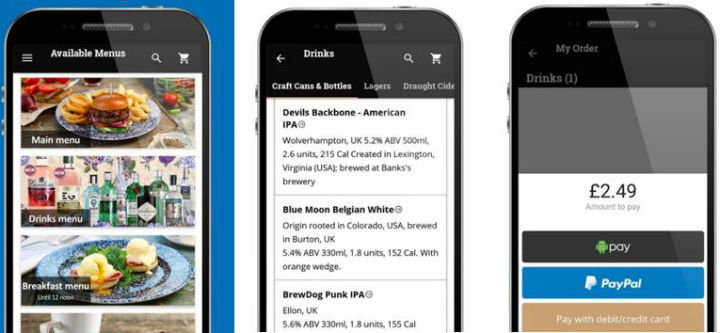 J.D Wetherspoon's app means pub-goers don't have to wait at the bar
Start to manage the unmanageable
But the corporate benefits of invisible payment don't stop there. The management information generated by a normal plastic card payment is pretty minimal — normally little more than the name of the restaurant and the amount paid. With an invisible dining payment app the entire spend information, not to mention full identification of the restaurant, is there for you to analyse.
And, of course, now that you can measure, you can also manage. Dining accounts for 13% of corporate travel spend, according to a study by German travel managers' association VDR, and yet it usually goes totally unmanaged. Invisible payment allows you for the first time to bring that category under control. You can see who your top restaurant suppliers are in a city and then negotiate discounts with them. You can not only set but also monitor policy on how much can be spent on a meal or how much alcohol consumed.
The three paradoxes of invisible payments
Invisible payment will become the norm for all aspects of corporate travel. Whether it is dining in a restaurant, taking a taxi or driving out of a car park, more and more travellers will pay their way without producing a piece of plastic.
Three intriguing and exciting paradoxes arise from this new way of paying.
- Payment will become easier and more flexible for travellers, yet corporate control of those travellers will also improve
- As payments become invisible, they become more powerful, and more central to travel management
- This cutting-edge technology sits on top of one of the most established concepts in corporate payments: the centrally billed account
Centrally billed accounts take centre stage
Centrally billed accounts are best known in the form of lodge cards: a card number is "lodged" with a travel management company to settle a client's flights and other transactions booked through the TMC. Businesses find lodge cards invaluable for many reasons, including fast reconciliation, control and unrivalled depth of management information.
Invisible payments allow companies to reap the same benefits of a centrally billed account after their travellers' trips have started. And the control is still there. The Wetherspoon app allows someone sitting at home to buy a drink for a friend sitting in the pub. There was a funny story in the UK newspapers recently about a young man in a Spoons who asked strangers via social media to use Order and Pay to buy him drinks for his birthday. The public responded to this cheeky request in a very British way: they started ordering and paying for the bar staff to bring the birthday boy pints of milk and plates of green peas.
It's a great anecdote, but there is a serious lesson for travel managers underneath it. It wasn't the birthday boy sitting in the pub who had the control; it was the people paying for him. That is where invisible payments tied to centrally billed accounts can take corporate travel in future.
Get ready for change
Of course this transformation isn't going to happen overnight. Our latest International Travel Management Study showed plastic still dominates. 63% of the 963 travel managers surveyed worldwide said their travellers used corporate cards to pay for travel, while employees' personal cards and cash were both used at 45% of companies.
However, I am sure the situation will change, and faster than travel managers might think. Only 19% of travel managers said they were ready to consider new payment products from providers like Apple, Google and PayPal. Another 33% said maybe. But we also interviewed 2,270 business travellers and a much higher 44% said yes and 39% maybe to the new payment types.
Also, think of the 600 million active users of the WeChat mobile payment app in China, and the millennials already using this kind of technology. They are the future of business travel. For them, invisible payment is becoming as normal as cheques were to a previous generation, and that is why invisible payment is also the future of corporate travel payment.