Value added tax, or VAT, is a type of consumption tax that first appeared in France in 1954. By the late 1980s some 48 countries had adopted a VAT system. Today it is present in more than 150 countries and accounts for up to a fifth of total global tax revenue, according to the Organisation for the Economic Co-Operation and Development (OECD) Survey, 2016. For the 90% of international businesses that incur VAT on foreign spending, VAT tax is a deeply embedded cost of doing business.
Increasingly, however, a growing number of finance and travel managers are transforming this expense into an opportunity. This is because VAT–unlike other tax types — can entitle businesses to reclaims.
According to VAT reclaim specialist VAT IT, a company with a US$10 million annual international travel programme can reclaim between $1 million and $1.5 million each year on average. Yet many travel managers are unable to fully capitalise on these sums. Approximately 72% of the businesses surveyed by the Organisation for the Economic Co-Operation and Development found reclaim procedures difficult to navigate and 20% were unable to recover any VAT expenses at all. OECD estimates suggest a staggering $20 billion in annual spend is left unclaimed.
Navigating complexities to uncover opportunities
A wave of new solutions is emerging to allow businesses to reclaim a greater share of their international spending. Travel managers and treasury staff are using these solutions to boost their companies' finances, save costs, and free organisational resources that are typically devoted to time-consuming manual processes.
For many companies, realising these benefits will require a shift in focus.
European travel managers often devote disproportionate effort and resources on VAT associated with domestic air travel. Yet this type of spending is only reclaimable in select jurisdictions, such as Germany, and usually constitutes less than 1% of total reclaimable value. International accommodation and travel can be a far greater opportunity, since this category typically makes up roughly 70% of T&E spending.
 But different regulations in various jurisdictions can complicate efforts to reclaim VAT spending in this category.
Of the world's 20 largest VAT economies, Australia, Canada, Germany, the Netherlands, South Korea, Switzerland and the United Kingdom have the highest refund efficiency rating. Even though European Union companies tend to be more knowledgeable about VAT, only 21% are able to recover all foreign VAT expenses, due to complicated rules and procedures.
Further, notable differences among countries can create uncertainty and confusion. For example, France doesn't allow reclaims on public transport or car rental, whereas Germany does. One-fifth of hotel spend is reclaimable in the UK, but only 7% is in Germany and 10% in Italy. The UK and Germany allow 20% of restaurant spending to be reclaimed, though France and Italy only allow 10%. And while some card providers offer VAT-compliant reports that can be submitted directly to tax authorities, these reports often only cover small segments of total spend.
Save time and costs, while boosting efficiency
Fortunately, today's new VAT-reclaim solutions automate many of these laborious processes, enabling travel managers to easily navigate complex regulations in multiple jurisdictions simultaneously. Global specialists are emerging to help companies capture this opportunity and streamline complexities by managing the back-end work of reclaiming VAT expenses. These specialists range from individual consultants to professional agencies and some of them offer end-to-end service and expertise in navigating complex tax jurisdictions.
Continued below
 VAT reclaim is becoming a big savings area ©AzriSuratmin/iStock
The more sophisticated solutions can integrate seamlessly with a T&E card and expense systems (such as Concur) to extract relevant spending data, which can then be submitted directly to the appropriate tax authorities. The specialists thoroughly examine all expenses, leaving no eligible spending unclaimed. Refunds are then transferred (net of fees) back to the companies, along with detailed spend reporting. And while card remains the best method for T&E expenses–due to the control, visibility and rich spending data–cash payments are also eligible for VAT reclaim.
In addition to the seamless integration with existing T&E systems, companies also benefit from easy setup. Depending on the size of the business and the number of subsidiaries, setup usually takes just a few hours and can usually be handled by the banking provider. Travel managers could opt for automated extraction via providers like Concur, online file sharing, or onsite retrieval, depending on their location and specific preferences.
An integral part of business planning
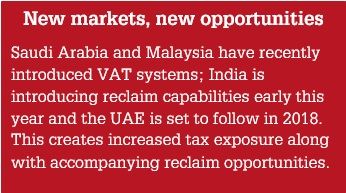
VAT has spread to every global region and will almost certainly continue to grow in the coming years. Many countries that already have a VAT system view it as a more efficient revenue source than income taxes, and frequently update their regulations to optimise efficiency and fairness. The growth in VAT means that any business with international expenses should be leveraging VAT-reclaim solutions. For companies considering activities in new regions or territories, VAT reclaim should be an integral part of business planning from the outset.
Whether you are looking to boost the efficiency of an existing reclaim programme or start one from scratch, consulting with your banking provider is often the best place to start. Banks already have a wealth of clients' spending data at their fingertips, and often work directly with VAT reclaim specialists who can provide a complimentary analysis to determine the benefits. Given the potential savings–and the operational benefits that can be felt across the entire company–the opportunity may be too great to ignore.