Imagine it's a Saturday morning and you are at home enjoying your first coffee of the day. A breaking news story comes in; a bomb has been detonated in downtown New York. Your head of sales is staying not too far from the blast site and his phone goes straight to voicemail. What's your next course of action to ensure employee protection? How much control do employers have when an employee is technically 'off the grid', where's the responsibility and how far must you go to ensure safety?
Of course the example given is an extreme and not all times of communication 'black out' are so dramatic. At dinner, driving to their next meeting or even relaxing in their hotel room are all situations where there is potential for risk. While foresight may be a necessary requirement, reaction time is equally as important. Technology, data and the future of duty of care is changing how travel managers react.
Looking beyond air and hotel
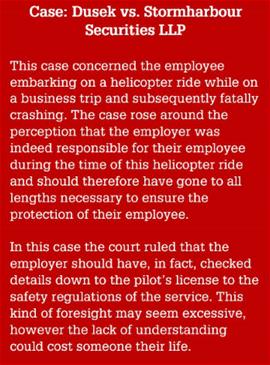 Both the head of sales case and the Dusek vs Stormharbour Securities (see box) are examples of incidents that the initial travel booking doesn't cover. Preparing for the expected and/or visible parts of the trip can be simple, it is qualifying the unpredictable risks that prove the biggest challenge for travel managers. For example one of the most frequently overlooked components of duty of care when it comes to reviewing the trip in its entirety is the management of ground transportation. This could involve any transport taken during the trip including local taxis, taxi boats and public transport.
On-trip, travellers are more likely to organise their own transportation rather than the company booking which can be monitored directly. Although this may seem the most practical and efficient way of conducting transport for the traveller it leads to a wider margin for risk.
This risk in particular has encouraged the formation of bespoke ground transportation programmes that take advantage of the most recent technological advances in app-based tracking, encouraging an Uber-like approach to traveller security. Accessing your employees' location at will on a map may seem a little 'big brother' but in security terms it could be ideal.
There's also the realms of liability and legality. If the traveller falls ill after a meal on-trip, is the employer liable? You would traditionally be swayed to think not, but the rationale behind incidences such as those I've mentioned are not always clear. Ensuring all lines of communication are open and accessible at all times is a big job, but also essential when compensating for an employee's safety.
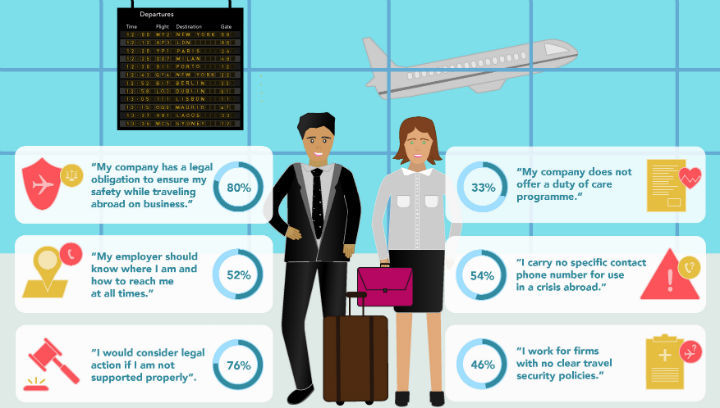
Below are some of the traveller perceptions from a recent GBTA survey.
Continued below
Support for employees during their trip is of highest priority. Implementing a 24 hour assistance service is the most efficient way to stay updated on traveller safety and security and key in ensuring a consistent support network for the traveller.
Pre-trip preparation is key and should be considered by both the traveller and the employer, whether it be in policy formation or facilitation of the trip. Having the right mechanisms in place minimises risk and makes for a smoother running of on-trip operations.
The future of duty of care
With the emergence of new technologies comes a heightened potential for duty of care provisions in all areas. As we continue to develop intelligent GPS mapping technologies, integrated workplace communication platforms and artificial intelligence device assistants, expectations when it comes to responsibility are rapidly evolving.
As these technologies progress, we see that communication and the ability to react quickly in an emergency or crisis remain top priority for travel managers, so what can assist them in this? Data clarity, organisation and the utilisation of predictive analytics are now evolving past 'nice to have's' into imperatives. Knowing where your employee is, if they are in a safe area and their psychological wellbeing at all times is becoming a basic expectation.
This insistence on real time updates can seem daunting for some, but maintaining the 24 hour assistance required for travellers can now be delivered through live chats and instant news updates, which can be particularly beneficial in specialised situations. For example, during a bomb threat where all telecommunications signals are disabled, Wi-Fi will remain functional, allowing the traveller to maintain contact with the employer throughout such a crisis.
The right to personal and data privacy is a hot commodity right now
The lines here aren't always clear. Despite an overwhelming 74% of business travellers agreeing with the statement that "My employer should know where I am and how to reach me at all times", it can be another issue altogether to actually implement this level of surveillance over someone. Both issues of trust and privacy come into play, which could add to the level of stress an employee experiences while on-trip.
Again it seems that striking that balance proves the most difficult for employers.
Planning for those moments between air and hotel and the periods of time that an employee is unaccounted for, certainly prove to be the most difficult when considering responsibility in its entirety. But evolving technology is generating more data and channels travel managers can utilise to improve coverage and visibility.