 While some lap up the life of a frequent traveller, more studies are coming out that discuss the negative effects of regular trips. Back in 2015 a university paper on the 'dark side' of business travel received extensive media coverage which was later assessed and a study revealed the types of policies causing 'traveller burnout'.
And now another new report from Columbia University's Mailman School of Public Health and City University of New York has specifically assessed travellers and non-infectious disease health risks.
Using medical data from 18,328 travellers assessed by EHE International, which provides corporate wellness programmes, the researchers found that those who travel for two weeks or more a month are more likely to suffer from anxiety, depression and sleep deprivation. The lifestyle means they are more likely to smoke, could have an alcohol dependence and are generally more inactive than others. It also found that the more nights away from home, the more likely there were behavioural or mental health concerns.
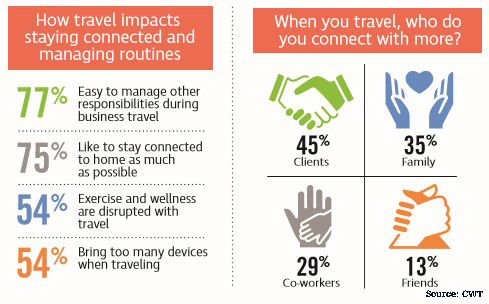
Some of these areas are arguably the traveller's responsibility. They could decide to choose healthier food options or exercise more. But we all know that the best intentions can fall by the way side. This infographic from CWT's Connected Traveller survey shows how some habits can slip and also where relationships can be strained
But the latest study calls for corporate culture that emphasises healthy business travel and provides training. Measures may already be in place for those that have been through a traumatic experience while travelling or have particular needs but, as we know, some problems are harder to identify.
Another way is to consider all aspects of a traveller's life. Microsoft is thinking about how to integrate all manner of factors not just into its travel programme but across the board to ease work and travel. Speaking at ACTE/CAPA, Microsoft's global travel BI and analytics Marta Rodriguez Martinez said this could include information about friends and family, airports, entertainment, weather, peers, school schedules: basically anything in life that may affect travel patterns.
Business travel is, of course, not always bad and destructive. But I think we're all in agreement when we say it can be easier.