India is a very large and heterogeneous country. With more than 2,500 IATA approved travel agencies and more than 60,000 non-IATA agencies, there are limited business travel contracts with specific TMCs.
No single TMC provider controls more than 2% of the business travel market in India. This means that the level of operating standards varies between globally accepted best practices to completely local home-grown solutions. It is common to find Indian operations of large global multinational companies working with standalone local travel agencies, although they do not fall within the commonly-accepted definition of the term TMC.
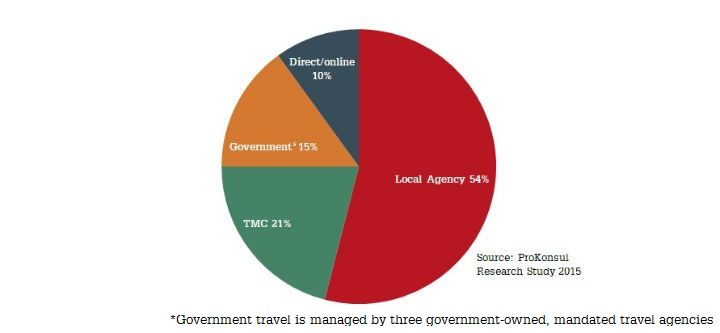
The distribution of business travel bookings by agency type or channel, illustrated below, outlines this.
There are multiple reasons why there are several approaches to travel management suppliers in India. Strong local agencies can deliver excellent high touch services (which are still valued in India) combined with operational capabilities and there are often historical allegiances and comfort levels with local partners. There are few professional solutions for this specific market and either because of ignorance or a lack of interest in sourcing best-in-class solutions. Some companies also do not feel the need for a TMC model that is nationally or globally integrated, sticking with their usual method instead.
The penetration of self-booking tools (SBTs) in India is also abysmally low with less than 2% market share. When combined with the limited use of credit card payment solutions, essentially the market is driven by high-touch operating and service delivery models.
What to expect from a TMC contract in India
There are common procedures that come with appointing an India-based local travel agent and the India-based divisions of global TMCs.
1. The appointment may not have a written contract and agreed service level agreements (SLAs) documented. Generally agencies can be appointed based with a general "letter of intent" or appointment letter which encapsulates the basic conditions.
2. A model of service based on providing onsite TMC staff at the customer location (also called implants). It's possible that the staff will be deployed in multiple locations across a specific city or nationally, and are supported by a team at headquarters.
3. The alternative to an implant/onsite operating model is the regular traditional full service offering where there is a team of agents fielding calls and emails. More advanced firms will have one or more 24/7 call centres but this is nowhere near a standard.
4. Travel requisitioning and approvals are generally settled via email between the employee who is travelling and the travel administration team/line manager. Automated requests and approval systems are largely limited to the top 10-15% of business travel customers.
5. Requests for travel are generated via email or "call to book" action by the employee/travel administration team and the TMC. The TMC representatives are generally expected to provide the three lowest fare options based on the travel request.
6. Based on the options provided the employee/travel administration team selects the best suited option and asks the TMC to ticket.
7. Almost all international travel from India by Indian nationals requires a visa so once an itinerary is selected the TMC will advise requirements. Visa services may be delivered by the TMC or an accredited third party provider but some companies have their own in-house visa unit.
8. General practice is that the TMC will not offer hotel reservations as part of their scope of work. Sometimes only domestic hotels and serviced apartments are managed by the TMC or the entire hotel reservation activity is managed by the internal travel administration team/employee directly.
9. Overseas insurance may be issued depending on individual company policy. Again, there are wide variations and many Indian employees will travel without insurance.
10. Another practice, though diminishing to some extent, is to issue currency and travellers cheques. Corporate credit cards are not common and individual employees, especially at a junior level, may not have their own personal card. There is now a growing trend of issuing foreign exchange debit cards that are loaded with the requisite currency so the traveller can then access money through a local ATM and withdraw what they need when required.
11. The overall penetration of credit cards is around 10% of the market. While all the primary credit card partners are operating in the market and offer a range of corporate cards, credit cards are generally viewed with a high degree of trepidation by business travel administrators. A majority of TMCs are paid using an invoicing model, with settlements done fortnightly/monthly.
General implementation leaves a lot to be desired. There are a lot of manual processes involved and these are subjective depending on the quality of the TMC agent and the effectiveness of the internal travel administration team. Obtaining quality MIS and reporting that actually offers some actionable intelligence is difficult and a significant area of concern.
That being said, there are pockets of global best-in-class implementation.
So is there a better way of managing travel in India? Absolutely.
In the last five to seven years self-booking platforms have been driving change. These tools are not currently the predominant mode of booking travel in India but they are gaining ground in the domestic air travel space; more gradually for international travel. This is mainly due to the greater level of automation. By 2025, India will graduate to being a largely SBT-enabled market with some limited manual intervention. This is already evident in companies that have already implemented best practice.
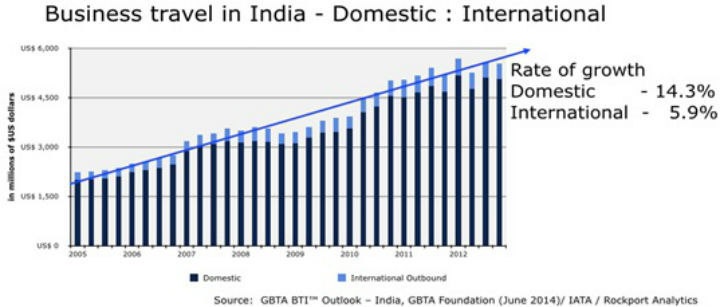
While many of the global players have established country operations, there are a growing set of strong homegrown SBT and 'iTMC' providers that are giving them stiff competition by developing India-centric solutions and flexibility. In India, the bulk of business travel transactions are domestic and the market is ripe for a quick transition.
The multi-national SBT and iTMC providers have so far struggled by not having the right structured 'go to market' strategy. They can be expensive and have a limited value offering. Further, they have been slow to adjust in developing solutions that the market needs. For example, the tools need the ability to source and display LCC content and offer complete one-way inter-ticketing between LCC and full service carriers.
Global SBT providers have far greater investments in user interface development, mobile technology, apps and the overall maturity of the solution which could make them more attractive to users. However, as these providers are technology focused they have not developed a strong set of in-house, in-country resources that correctly articulate the value of their tools as well as the project management skills to perfect the operational side with TMCs and buyers. They are further constrained by the inherent desire of most TMCs to maintain status quo and avoid investments to 'up their game' and move out of the implant and call-to-book model. It might be contradictory but is a fact.
Very few TMCs, including global players in India, have really understood or invested in developing new innovative business models or even implementing what they have in other markets. Indian leadership teams don't really understand the power of the technology available and believe quite earnestly that self-booking technology cannot work in India.
Multinational TMCs, with some exceptions, do not really work as extensions of global enterprises but rather as Indian operations of a multinational TMC. There are significant differences with their international operations. Unless you as the client are clear in your expectations and deliverables it's often seen that the status quo prevails. There are also some TMCs that deliberately want to perpetuate the opaque legacy practices which are conducive to 'creative ticketing' and other malpractice like fare upselling and refund management.
A significant other in this discussion is the average Indian business travel buyer/travel manager. Many of them have progressed to their role from previous positions with travel agencies and/or without structured training and an understanding of best practices in business travel. There are very few options for training in business travel best practices, unlike North America and Europe, and buyers do not have the option of learning from peers or elsewhere.
TMCs have generally played on this knowledge gap and the inherent insecurities when implementing an 'unknown, untested' solution like SBTs. Further, these insecurities are incremented when colleagues in India find that almost no TMC recommends the use of technology upfront.
A lot of TMC inefficiencies are then placed on the clients, including the below.
- The Indian propensity that negotiating the lowest transaction fees is the primary benchmark of success in business travel.
- Costs to house implants and resources at the client site, which can cost at a minimum US$ 750-$1000 per seat per month in rent and facilities. A three-person implant effectively means the client is incurring US$30,000 in occupancy costs alone.
- The client has to set up and support an entire infrastructure to perpetuate the legacy operations, when it's possible to operate with a minimal travel team as is been shown worldwide.
- The biggest hidden cost is the concept of 'employee time cost' which is the average time taken by employees to process travel from planning to expensing. This is taken as a factor of the average hourly wage. We've seen multiple case studies that the impact of this cost exceeds by 1000% more than the average transaction fees charged in legacy business travel operating models.
Setting clear targets and goals are required to achieve success and challenge the status quo. Change can be driven successfully if the customer has a clear vision and an appreciation of the complexities, challenges and opportunities. Directly importing an international model is a sure-fire disaster. So is settling for a legacy outdated mode of operation. It requires a combination of strategy, transition planning and communication to get the travel programme right in India.