 Travel payment providers are ramping up product development as the widespread use of contactless brings new opportunities and partnerships.
Business to travellers
Speaking at the ITM Conference Ross Cooper, senior business development manager — travel partnerships at Barclaycard shared that the corporate versions of Visa and Mastercard will be available through the likes of Apple Pay "soon", meaning travellers will be able to connect their corporate card to their smartphone wallet and wearables. This will make payments as easy as it is for personal purchases but there are other benefits. "It opens up the potential for virtual card to be sent to mobile," he added. "So it's almost a pre-paid option and the buyer can choose/limit what it is spent on."
 Cooper also showed off watches that have a bPay chip installed (pictured) and revealed that devices that use a 'passive chip' such as these have no foreign exchange fees. Currently itemised detail is only available if entered manually but is likely to be coming in the next few months.
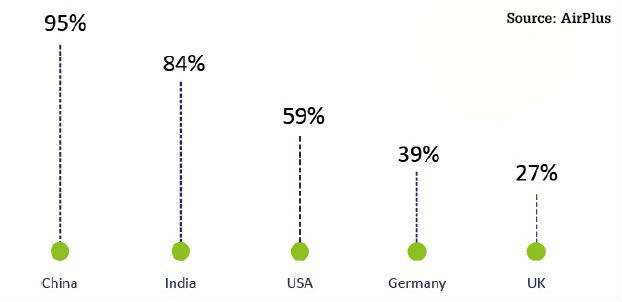
With the below table showing how smartphone payments are becoming the norm (the USA figure does not surprise me given most don't have contactless cards yet), it will not take long for this to take off. In addition more restaurants and outlets are designing apps that integrate payment as described by Patrick Diemer in this Expert piece, which users could connect to their corporate card similarly to Uber.
Business to business
Amid these changes integration and simplification have become the central themes in B2B payments. At a media briefing last week Spencer Hanlon, managing director of AirPlus shared how it is looking at ways to integrate along the chain whether it's in the booking process, search, expense, approvals etc.
"Travel managers have influence and we know the policy or hotel; the majority of trips are an identical plan. So, for example, when there's one button with 'do this trip again' we can link into that," Hanlon explained.
He said there has been an "explosion" in virtual cards adoption with Paul Spelman, UK country manager adding that the majority of UK growth is from travel agencies looking to use virtual cards to make more hotel bookings.
As a result, Hanlon said the firm is "deliberately taking the strategic view to move away from company card to a single pan-European corporate card" with an initial launch in France this September before being rolled out to 18 other countries. It will encompass a single company account, lodge card and virtual payment with one portal and one single contract covering multiple currencies and languages (travellers will keep the same cards, it will just be processed differently).
Meanwhile Conferma has partnered with Mastercard so banks and travel management companies can issue their own virtual cards; again citing a boom in the payment method but also as a means of collecting more spend data.
We've long heard about the benefits of a connected ecosystem. Is payments the bit that ties it altogether?