Online booking tools (OBTs) have become an integral part of our daily work lives but adoption can stall as business needs change and industry connectivity evolves. Some travel buyers complain of non-compliance when they have 98% adoption and for others the savings achieved at only 50% adoption may still be higher than the cost of the technology. Furthermore, most travellers don't like using OBTs.
We have to question if adoption is actually a useful measure. A better measure might be 'which trips are not booked online and why' or to look at the percentage of adoption among bookings suited for OBT use. Considering the above we should temporarily abandon compliance figures and reassess what we use our corporate OBT for.
Is your OBT still fulfilling its purpose and what can you do to make it more attractive for travellers? Ask yourself:
- Is your OBT current and/or have business needs changed?
- Do you offer support needed to drive compliance?
- Do you offer services your travellers want and require?
- Could the touch and feel of the tool be better?
- Do you have a site beyond the OBT and is it fun to use?
- Could free add-on services enhance compliance?
- Are you offering technology that people use in their everyday life?
Traveller needs are changing
When you selected your OBT you most likely made a needs-analysis, talked to businesses about their requirements and determined the OBT services best suited to your travellers. Most probably many years have passed since the implementation and business/traveller needs may have changed. Here's a simple analogy to illustrate this point — you are running your corporate cafeteria and your initial analysis showed that people wanted to eat hamburgers. Over time people demanded more variety and you also added other food choices, yet you notice that sales stagnate or even decline. What do you want to do to stop this trend; offer other food products? Force people to only eat at your cafeteria?
You decide to update your analysis and realise that food variety is just one aspect but that the main issue is the overall change in dining behaviour. People do not want to eat in a cafeteria every day, they want the experience of different restaurants, they want to meet others instead etc.
Needs and requirements change over time and a decline in usage/adoption cannot simply be reversed by offering more choices, advertising your service, arguing price savings or forcing compliance.
Our travellers know more
The introduction of OBTs was a turning point in corporate travel and revolutionised the way we interacted with TMCs. Our travellers understood the benefits of OBT usage but, as with our cafeteria analogy, people want to explore other options. The main challengers are the rapidly growing online booking platforms like Expedia, Travelocity, Kayak, Trivago, etc. While there are differences between those services, let's just call them online travel agencies (OTAs).
When comparing OBTs and OTAs we notice drastic differences. OTAs are more intuitive with a better touch and feel. They offer more options that drill-down choices, crowd source information for comparison and allow social media interaction. The big draw of OTAs is not that they can do a booking any better than an OBT - simple, cost-effective and compliant - but that they offer a flood of free services/information that make the booking process fun and enjoyable.
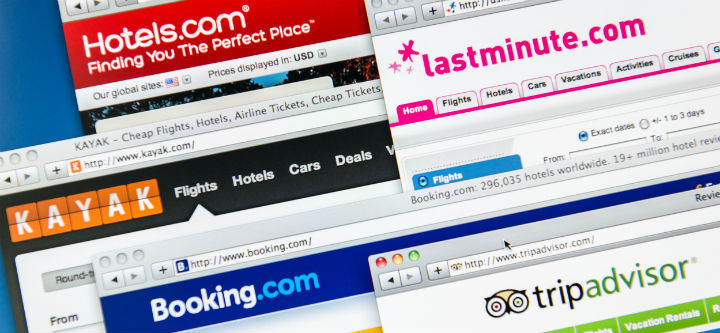 Some of the OTAs travellers like using ©franckreporter/iStock
Our travellers know the OTA (dining) experience and are not finding it in our OBT (cafeteria). If touch and feel, ease of use, enhanced information, crowd-sourced data and social media access is what makes people tick and makes booking online more fun, then let's be guided by that.
Where you could focus
Support, support, support!
One of the most basic issues is the support of an OBT during daily use. When a traveller has a problem with the OBT, he/she will call the TMC that determines it's an OBT issue and the caller has to then call the OBT team. There he is advised that he is making an error and should review the training video and start again. While all the steps were correct, and it may have been the traveller's lack of OBT-knowledge that caused the issue, we may end up with an employee that will do anything to avoid the OBT in the future. Getting a disgruntled traveller to like a product again is 10 times more difficult then having hand-held the person in the first place.
Let's look at a more pleasant approach. The traveller has an OBT issue and calls the TMC. They will ask if they would like to be talked through the process on the phone or if the agent should do the booking over the phone right now and plan a follow-up call when there is more time. The booking is made, the traveller is happy and the OBT issue is being resolved.
Naturally this has a higher cost attached but having the detailed data on why people struggle, how often a person needs to be walked through etc. will help you to understand where you need to focus your resources.
Create interest with little to no cost with destination information
Travel managers often cannot change the OBT itself or offer OTA usage to travellers, however, they can create an OTA-like environment alongside the traditional OBT. Buyers need to create sites that are rich of information that travellers can only find on the company page. This page does NOT come with a cost for additional services other than having the IT department help create and develop. This information must be available on the intranet, the web and on mobile platforms. Naturally it will offer the classic OBT booking channel but primarily offer a huge variety of information to travellers.
What travellers need most is truly useful information on their destination.
- A hotel location should be clearly marked in the overall context of the city, airport proximity, office location, client site or conference venue and not just a blob on a map.
- The destination and address should always be in the language of the destination country. Providing a driver in China with a local address written in English is not very practical.
- Provide detailed airport information in the context of the actual trip. Is there more than one airport? How long is the trip from the airport to the city, both in distance as well as time (just in case your traveller gets nervous if a 20 km trip takes over one hour)? What is the expected fare?
- Should a traveller walk in a city, use public transport, a taxi or a car service?
- What about safety and security, emergency numbers, embassies, hospitals, etc.?
It seems a daunting task but all of this information can be added to a simple Google map and provided to travellers via a downloadable pdf. This is minimal effort with a product offering that the traveller can only find on your site.
Use modern communication platforms
Crowd sourcing can be a huge source of information. Just imagine that one of your travellers is having problems during check-in at an airport. What do you think the preferred way to complain about the experience will be — call the home office (time-zone permitting), sit down and write an e-mail or vent their frustration via Twitter or Facebook?
Social media is the more likely path but receiving information from your travellers on public sites can have serious consequences, so why not communicate with them using these platforms but in a private mode? It is easy and free-of-charge to start a closed user group on social media, allowing people to communicate instantly and still keep information confidential. Depending on how often and who monitors them, some issues can be solved within minutes and provide not only instant service recovery but also a detailed incident log — do I hear vendor compliance?
Your own vendor rating system
When travellers go to a hotel, they frequently research the property way before they actually leave home on sites like TripAdvisor, even if they are a return customer. Here every person can rate a hotel, restaurant, airline etc. but how useful is the opinion of Grandma Betsy from Bristol, some spring-break teenagers from Boise, Idaho, or the newlywed couple that didn't get the honeymoon suite?
What travellers, and buyers, need to know is how fellow employees are rating the corporate hotel. An annual survey could be done but, in the example of the airport incident above and the use of social media, wouldn't you rather have the information collected immediately and be able to initiate a service recovery than feedback once a year?
Working with your IT department it is very simple to set up an internal webpage, next to destination information, where people can rate and comment instantaneously on the service delivery of your vendors. This will not only provide valuable information when talking about traveller satisfaction or vendor compliance but it also gives people the 'this is personal and my opinion matters' effect that make OTAs so successful.
Why are all these services not already available from your OBT?
A lot of the large OBTs are either owned by GDS companies or mega-TMCs, hence they already have the technology but are not employing it in their OBT corporate offerings. According to some OBT providers "the corporate customers are not interested in this".
With the continuing struggle to keep compliance high, I would argue that any travel manager would gladly welcome products that help them achieve this. Also, during any vendor review it may be a good way to rate OBTs/TMCs on how close to an OTA their service will be.