American Airlines this week announced some product initiatives specially designed for its corporate clients.
The benefits for corporate clients' travellers are apparent: access to priority boarding, security and boarding and complimentary seat selection. There is also an "auto re-accommodation" to rebook these travellers should their flight have been affected by cancellation or delay.
But it is the tailoring of its SalesLink tool — "SalesLink Insights" — for corporate travel managers which is of greatest interest.
SalesLink was introduced as a tool for travel agents and TMCs to analyse its performance in relation to its sales rewards' targets. It now has a corporate dimension.
In American's words, "With this new portal, you now have access to a more dynamic and transparent view of your corporate program with American.
"Features of SalesLink Insights include:
- The overall value of your relationship with American and our Joint Business partners
- A deeper dive into your contract savings
- 'What If' scenarios to help you discover how you can save more
- Access travel data to find the top performing and best opportunity markets
- A summary of all ancillary products purchased or provided by American
- A look into your travelers' customer journey and operational statistics"
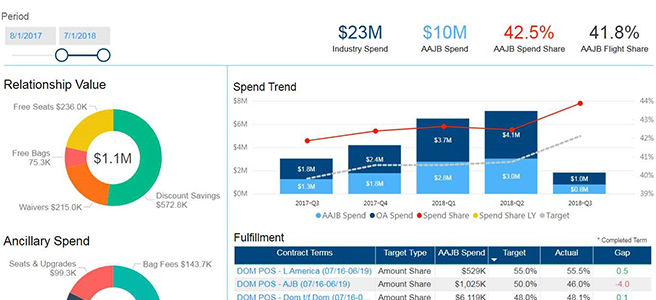
Just as a consumer would expect from any data tool, SalesLink Insights offers the ability to download and export.
However, the tool has not been especially created for corporates. It's a tool which American developed for agencies that it has now been adapted for its corporate customers.
In one way it's surprising that this hasn't been done before because the mechanics of the tool — measuring source, volume and pattern of bookings — provide data which both TMC and corporate customers can use to maximise the volume and ROI of the supplier relationship.
The point at issue, however, is reminiscent of corporates' relationships with bookings. If data which corporates are undoubtedly eager to have comes from individual suppliers rather than being consolidated through an intermediary, there will be the issue of making the input consistent to make sense of any consolidated results and outcomes.
It will be a trade-off. The closer any data is to the source, the more likely it is to be accurate and complete. Moreover some of the platform's line items are clearly attractive and have previously been difficult to consolidate, namely ancillary products purchased by the traveller post-booking.
The other feature that travel managers should be eager for is the "what if" scenarios. Not only are they directly useful for the manager but they are extraordinarily helpful for communicating to department heads and line managers the effect that changes in behaviour and policy can make (https://www.businesstravel-iq.com/article/2018/08/16/how-to-use-data-to-further-your-cause ).
American should be commended for offering and highlighting this platform and its functionality to its corporate customers.
Will its TMC partners be similarly pleased?