The technology provider CarTrawler, which
connects buyers to sellers of ground transport, has published its much-anticipated
annual report on Airlines’ Ancillary Revenue.
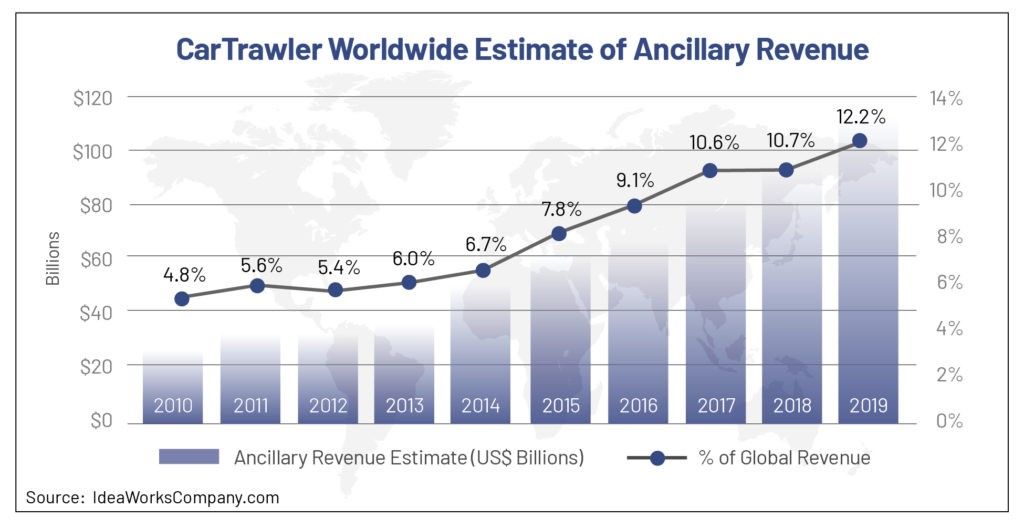
“Global ancillary revenue is projected to
pass the $100 billion mark in 2019, marking an almost five-fold increase in the
segment’s value since 2010,” said CarTrawler chief commercial officer Aileen
McCormack.
And, even more interestingly, the 2019
edition confirms the trend for these revenues to comprise an increasing
share of carriers’ total revenues:
Air extras are undoubtedly an important
issue. At one time buyers would thump the table demanding full content but
LCCs’ practice of disaggregating content has led to its generally not always
being available at one time or in one place.
The proportion of what we spend with
airlines on fares is dwindling as these ancillary revenues increase. The growth
of online shopping has made consumers more price-led in their decision-making
so it’s understandable why airlines, who know only too well that the buyer
might be swayed by £10/€10 when booking but will happily spend that money once
at the airport on incidental spending, do this. As way of example, earlier this
year Heathrow Airport reported that average spend per passenger at the London airport
increased 5.8% from 2017 to £8.94.
Airlines want more revenue at the time of
booking (hence the impetus for incentivising direct and NDC bookings) so want
to minimise the temptation to buy sushi in the airport rather than a ham
sandwich on board. Managers want every cost of the fare presented at the time
of booking to increase controls and facilitate data capture.
Ancillary revenue overall may continue to
rise but corporate travel buyers may shortly notice it shrinking.
ATPCO’s Next Generation Storefront. NGS was
first outlined at the company’s Elevate conference in 2018 by a panel
comprising American Airlines, Delta and United.
NGS will allow bookers to 1) shop by comparing multiple airlines through
standardised data which describes services and delivers a framework for
creating comparable products and attributes; 2) shop by attribute – product
quality, content, and capability – not just price; and 3) display all the
relevant data so that the traveller or booker can make an informed decision.
More than 30 airlines including British
Airways and 20 aggregators including business travel management platform
TripActions are part of the NGS initiative.
Having a retail solution which shows the
different attributes that marketing teams work so hard to communicate at the
time of booking can solve a number of corporates’ challenges:
• Fragmented booking channels
– Improving the functionality of one approved booking channel should make the booking
process faster and easier for travellers and increase compliance to travel
policy and preferred suppliers. The three main GDSs are all working with NGS so
there should be no issues about this being available on corporate OBTs.
• Fragmented content –
The problem of being able to purchase a seat on a specific flight but nothing else
that might be required from seat selection to the ability to check baggage has
been removed. The whole product can be specified and purchased at the time of
booking.
• Fragmented data – Purchasing
the full air product at the time of booking removes problems stemming from
having to consolidate it from different sources such as expenses.
• Reimbursement policy
– The more that a fare or rate is disaggregated, the more elements there are to
be judged as eligible (or not) for reimbursement. This can be challenging for
corporate cultures which are otherwise working to bring colleagues together –
why does one traveller always need to check a bag for a two-day trip when
another doesn’t?
And new examples pop up all the time. There
is talk in the US about charging passengers for the privilege of, err, charging
their devices. Is that reimbursable? Would a traveller purchasing a portable
charger be reimbursable? But then would only travellers be eligible to score a
portable charger on the company?
In its report CarTrawler contends that
ancillary revenue has remade the business models of the global airline industry.
It also presented new challenges for travel manager. For years most moaned
about leakage caused by flown data being split between the booked fare and the
ancillaries which were usually purchased on expenses at the point of usage.
Both airlines and corporates are set to
benefit if every element of the air journey is purchased at the time of booking.
Airlines are scrambling to implement NDC
and NGS to ensure that bookers and travellers have a retail experience rather than
only the fare and the schedule being visible on the GDS screen.
Having full product and service details at
the point of booking will make life easier for bookers. However, early trials
of NGS have shown that it has the potential to be more lucrative for carriers.
One pilot for Upside Business Travel showed a 62% increase in premium bookings
while a second, independent pilot for TripActions showed a 33% increase in
overall bookings.
While shopping for ancillaries is set to get
easier, it looks like it will be the corporate buyer that pays for that better
experience. The line in the chart above, whether it is labelled attribute or
ancillary revenue, looks certain to keep on rising.