T&E company Certify released its annual Travel & Expense Management Trends Report this week.
The research, which is based on 585 responses to a survey conducted during May and June, found that only 72% of companies have a formal T&E policy in place.
The company reported, "Of these companies, 58% report that their travellers' understanding of their T&E policies is, at best, "decent — but in need of improvement. Even more troubling is that 20% of companies that have a T&E policy in place report that the understanding of their T&E policy by travellers is 'minimal at best'. How can a company expect policy compliance without investing in educating its travellers about the policy's rules and purpose?"
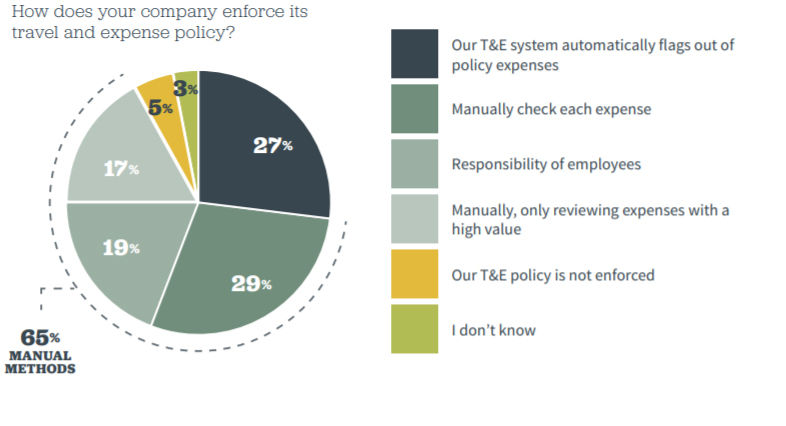
Source: Certify 2019 Travel & Expense Management Trends Report
Only 27% of companies had a system which would automatically flag an out-of-policy expenditure while 65% relied on a manual process to deal with expense claims.
Although the report as expected highlights the cost and convenience advantages of using an expense management system, it surprisingly reveals an even bigger concern, as shown in the chart below.
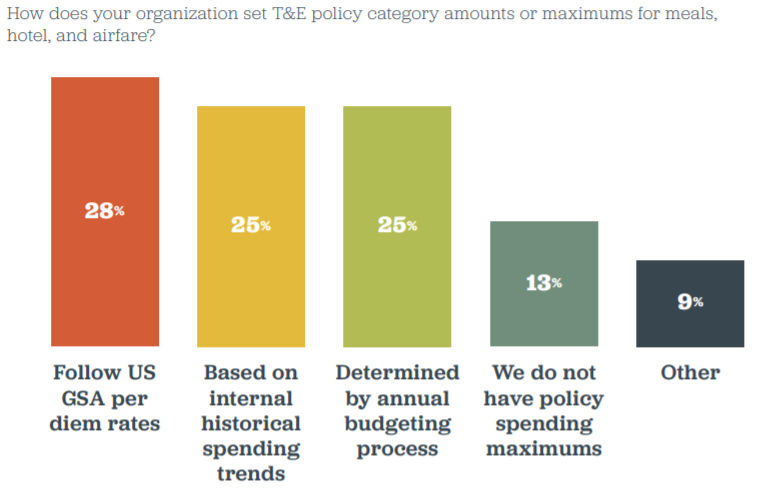
Source: Certify 2019 Travel & Expense Management Trends Report
Both of the two highest-scoring methods — "Follow US GSA per diem rates" (28%) and "Based on internal historical spending trends" (25%) — do not relate to the specific company's own objectives which is very odd given that most people would describe business travel as that which underpins a company's corporate strategy.
The first category is safe — if these rates are good enough for government workers, they should be good enough for our travellers — but irrelevant to the specific organisation's sector, culture and position. At a time when traveller well-being, recruitment and retention is rising sharply in importance, this approach of seeing business trips as a commodity, namely getting from A to B, should be raising eyebrows.
The other option — "Based on internal historical spending trends" — is standard operating procedure in public sector organisations and the default option for many businesses.
History does not in itself deliver a policy which takes account of the business as it is now operating. Is it consolidating and cutting costs or is it in expansion mode and acquiring businesses? Are there new destinations which require new suppliers and rates being taken account of in the programme? Companies' characters can change. A company-wide shift to becoming a more environmentally aware brand might mean adapting a policy — and per diems — to encourage more use of rail. Management strategy could evolve to requiring more senior employees who could be attracted by a more generous travel policy.
If business travel is indeed to support corporate strategy, the travel policy must reflect any changes in company activity from sales and marketing to HR in that policy. This is now possible with predictive data.
More than 50% are not connecting their travel policy guidelines to the volumes and projects that their company are planning to undertake.
At the least the research shows that more corporates need to consult with other internal stakeholders to understand what they want to achieve rather than just rely on what happened in the past or what happens elsewhere.