The rising costs of business travel in Europe are going to slow in 2020 as "a raft of uncertainties are set to put a damper on pricing".
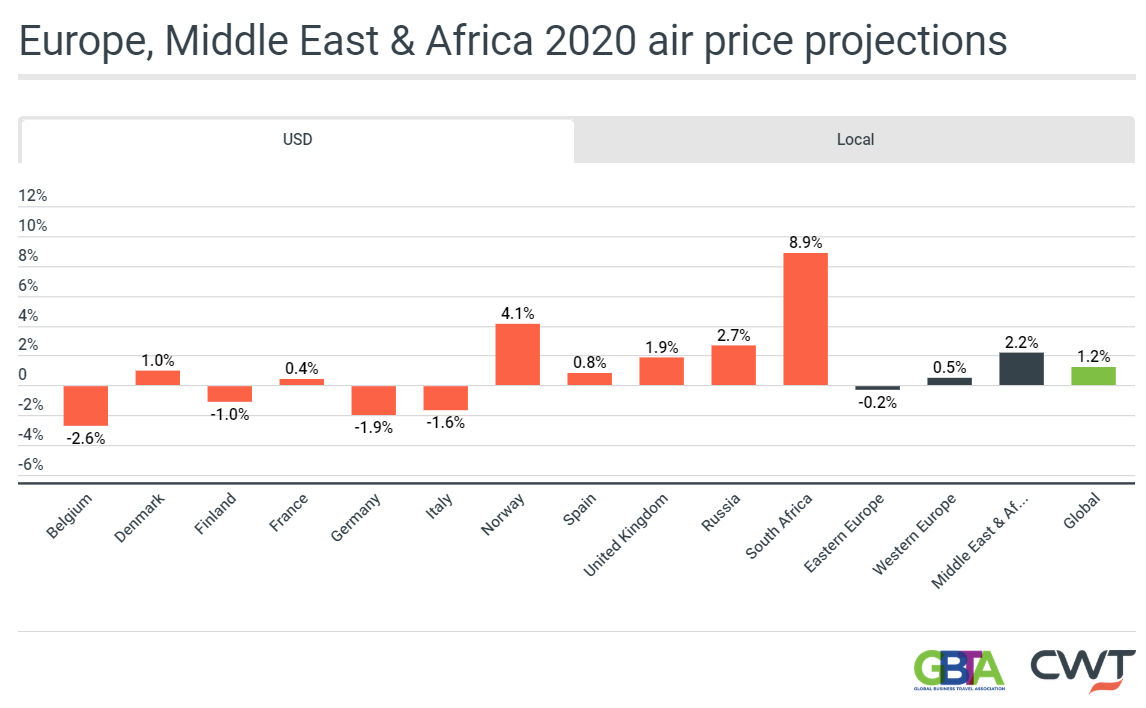
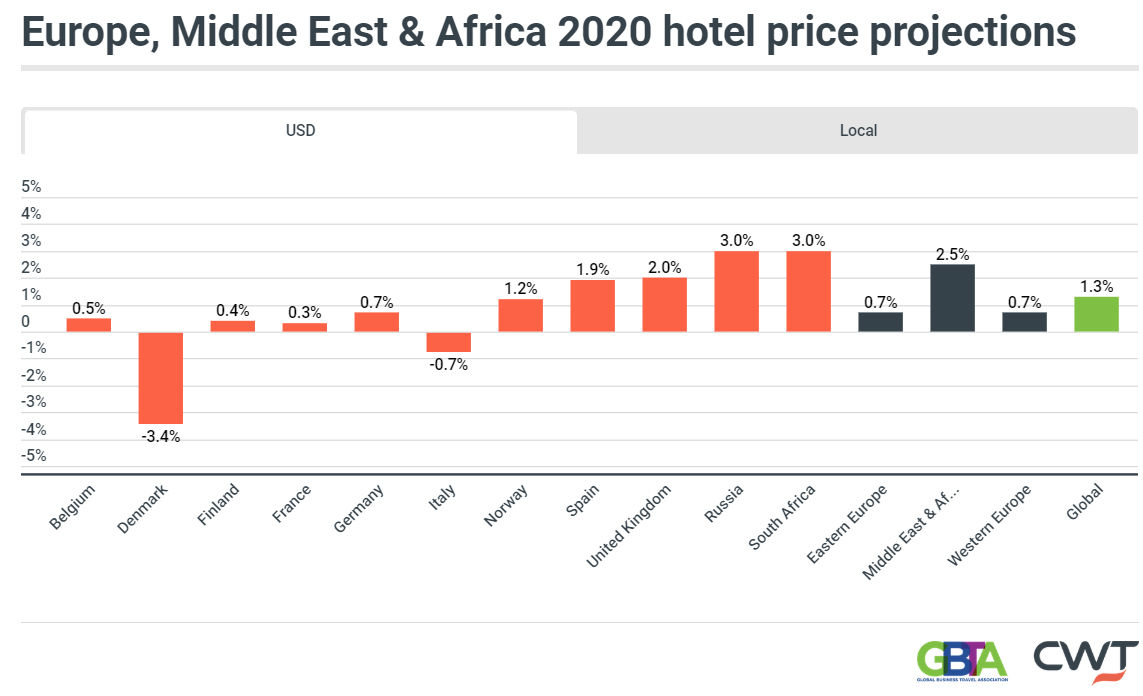
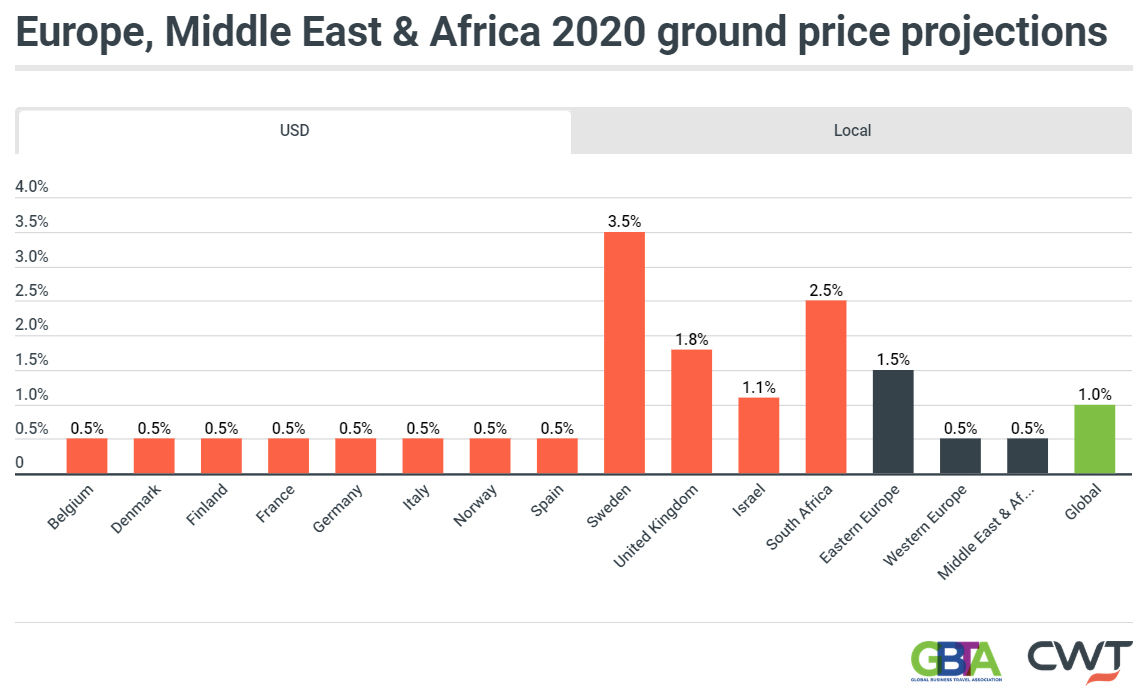
The sixth annual Global Travel Forecast, published by CWT and GBTA, shows that air fares will rise by an average 1.2%, hotels by 1.3%, and rental car rates by 1%.
These increases compare with 2.6% (air), 3.7% (hotel) and 0.5% (car) forecast for 2019 in last year's report.
The slower price growth is attributed to various macroeconomic uncertainties, despite global forecast GDP growth of 3.6%.
"The risks and ambiguity have increased over the past few months — not least the threat of escalating trade wars, the impact of Brexit, possible oil supply shocks, and the growing likelihood of recession," says Kurt Ekert, CWT's president and CEO.
Price increases in Western Europe are set to be even more muted — 0.5% for air fares, 0.7% for hotel rates and 0.5% for car rental. The breakdowns by country are shown in our charts this week.
Richard Johnson, CWT's senior director, solutions group EMEA, says "These increases are fairly modest and part of the reason is that the factors causing uncertainty are also moderating how high those increases are likely to be. The softening of demand could act as a check and balance to prevent price rises from becoming higher."
Focusing on air, Johnson says, "What we might see is not so much a drop in traffic but a downgrade in cabin class. Statistics from IATA show that premium seats account for 5% of seats flown but 25% of airline industry revenues.
The new Istanbul Airport (Havalimani) will also act as a brake on fare increases, says Johnson. "It is creating new frequencies and new scheduling opportunities to capitalise on strong demand to oil and gas destinations, such as the Middle East and Africa."
Hotel chains are being challenged by a proliferation in "sharing economy" offerings such as Airbnb for Work as well as the new Homes and Villas by Marriott offering. Both Hilton and Wyndham have recently downgraded their RevPAR forecasts as a result.
Johnson says the way hotels are sourced is changing as a result of this.
"When occupancy rates are high then last room availability and negotiated rates tend not to add as much value as they can be hard to get. The promise of corporate volumes can actually act as a disincentive to a corporate deal when higher rates can be secured on the open market. We are seeing a growth in chainwide discounts and dynamic rates forming the basis of corporate contracts and deals are increasingly being done for two rather than one year."
Looking at uncertainty in the UK, and Brexit in particular, Johnson says his namesake Boris, the new prime minister, has "at least put a more definite stake in the ground but whether that is a good or bad thing in terms of business confidence it is probably too early to say."
He says, "The reality of whatever happens with Brexit is that businesses will need to operate and planes will still fly. We are not going to see a doomsday scenario. What we might see is a softening of demand between certain hubs, eg financial sector destinations. Corporate travel buyers will capitalise on that as airlines will still want to sell those seats. Other sectors might take up that slack."
He adds that it is too early to quantify the long-term effects of a potentially weaker pound.
He says, "If the exchange rate [against the dollar] remains low or gets lower and as Brexit becomes clearer, that is potentially something to be factored in for future travel programmes. Day to day, companies will still be making business critical trips.