IATA's end of year report is like a health check-up for the aviation industry.
And, despite the sense of economic foreboding that seems to have gripped many analysts and commentators, IATA thinks things are looking reasonably good, in part because oil prices are so low — jet fuel is now down to the same price it was in 2009. Whether this translates into lower fares remains to be seen, however.
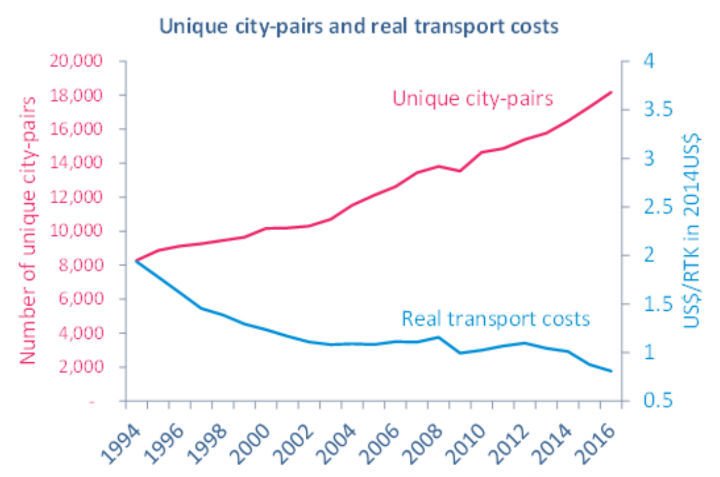
One of the more interesting charts in the IATA report looks at the world's connectivity.
The chart this week shows how the number of city pairs has grown significantly over the past two decades. The association believes that the number of city pairs will grow to more than 17,000 in 2016, up from 8,000 20 years ago. In just one year, it expects airlines to add 500 new city pairs.
It says, "Economic development worldwide is getting a significant boost from air transport. This wider economic benefit is being generated by increasing connections between cities — enabling the flow of goods, people, capital, technology and ideas - and reducing air transport costs."
The chart also shows these costs; it says that transport costs in real terms have halved over the same period. Lower fuel prices have helped recently but the main gain has come from increasingly efficient aircraft. It predicts that fuel efficiency, in terms of capacity use, will improve by 1.8% in 2016 and argues that such fuel efficiency gains have "partially decoupled CO2 emissions from expanding air transport services".