Air travel remains the single largest contributor to most companies’ business travel emissions, yet reporting on this impact is anything but uniform. In this Databank article, we analyse newly released datasets on airlines' environmental credentials (from Envest Global) and disclosures from corporates on their scope 3.6 emissions (from Areka Consulting).
The findings reveal a patchwork of measurement, transparency, and accountability: some organisations are now publishing detailed travel emissions data with finance-grade assurance, while many others still report little or nothing at all. Meanwhile, airlines' decarbonisation efforts are heavily reliant on the use of alternative aviation fuel which remains, for now, something of a rare commodity.
Envest Global collects airline emissions data in order to present travel industry stakeholders with objective, consistent and transparent sustainability performance information. Corporate travel managers are among its customers, who are using the company’s analysis and dashboards to help determine its preferred partners.
The company provides a vast set of metrics for the 100-plus airlines on which it reports but believes carbon emissions per revenue passenger kilometre (CO2/RPK), measured as grams of CO2 per kilometre (gCO2/km), is the most telling of all.
Among the key criteria affecting this figure are an airline’s average fleet age, passenger load factor, and use of sustainable aviation fuel, which all contribute to the Sustainability Rating that Envest Global attributes to an airline. That rating is a measure of an airline’s overall sustainability performance relative to other airlines, based on a weighted blending of a range of KPIs.
Envest's ratings are focused solely on carbon emissions, rather than a broad ESG rating, and although it collects data relating to carbon offsets – which is limited and lacks detail – that information is not used as a KPI in determining sustainability ratings.
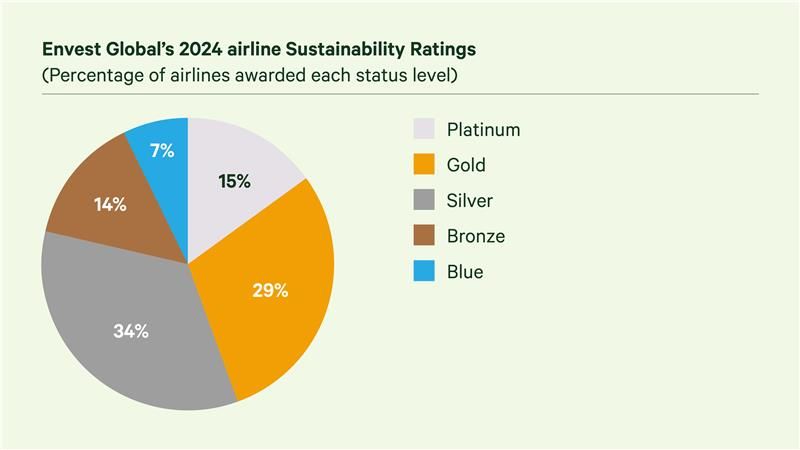
Based on 2024 data, Envest Global awarded Platinum status to 13 airlines and airline groups including Wizz Air, Ryanair, British Airways, Iberia and easyJet. A further 25 operators were awarded Gold status, 29 achieved Silver, 12 achieved Bronze, and six were given Blue status where no or insufficient data is reported to enable an assessment.
 Source: Envest Global
CARBON EFFICIENCY
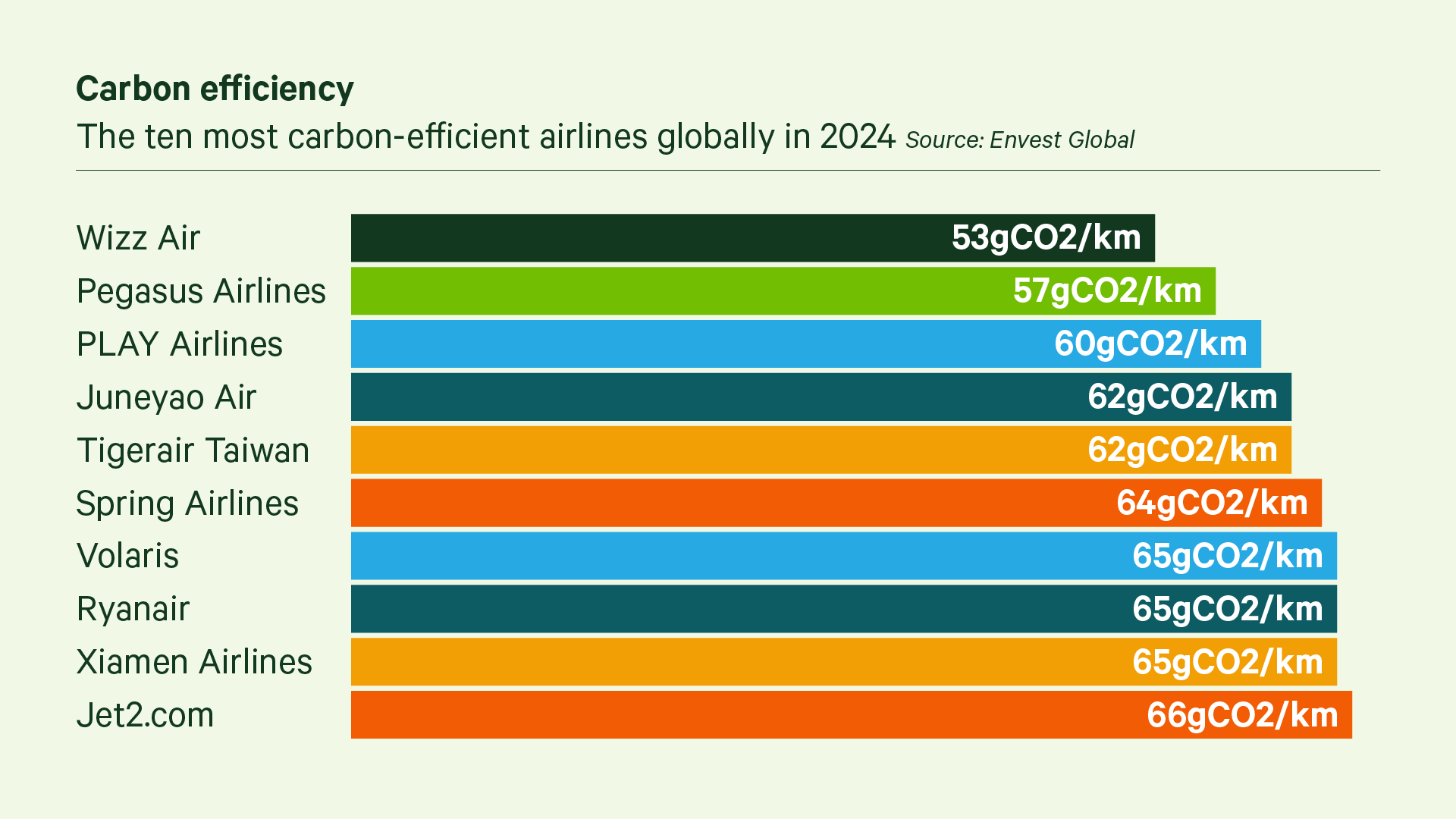
Across all airlines, the average carbon efficiency is 89 gCO2/km. Notably, low-cost carriers have collectively improved their carbon efficiency, reducing from 79 gCO2/km in 2019 to 72gCO2/km in 2024, and now operate at 77 per cent of the emissions intensity of full-service carriers. At 53 gCO2/km, Wizz Air is the most carbon-efficient airline worldwide. Conversely, SkyWest Airlines, Croatia Airlines, Royal Jordanian, Bangkok Airways and Philippine Airlines are among the least carbon-efficient operators globally
 Source: Envest Global
THE USE OF SAF
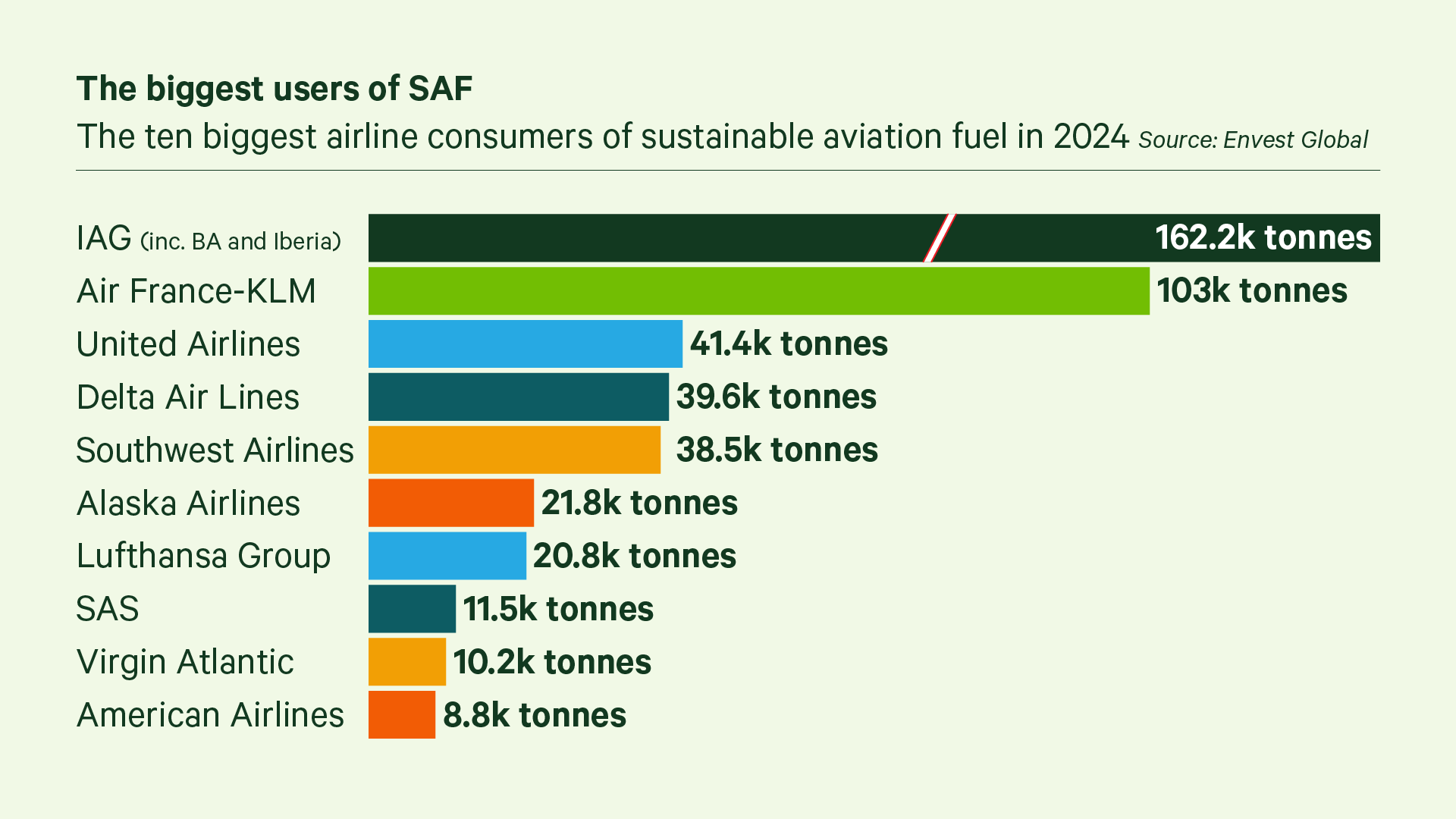
In 2024, sustainable aviation fuel (SAF) accounted for just 0.3 per cent of fuel used by the industry worldwide, and 70 per cent of that was consumed by European airlines. IATA's decarbonisation plans – and those of many other aviation organisations – rely heavily on the use of alternative or sustainable aviation fuel. SAF accounts for 65 per cent of aviation's carbon reductions in IATA's net zero 2050 pathway.
 Source: Envest Global
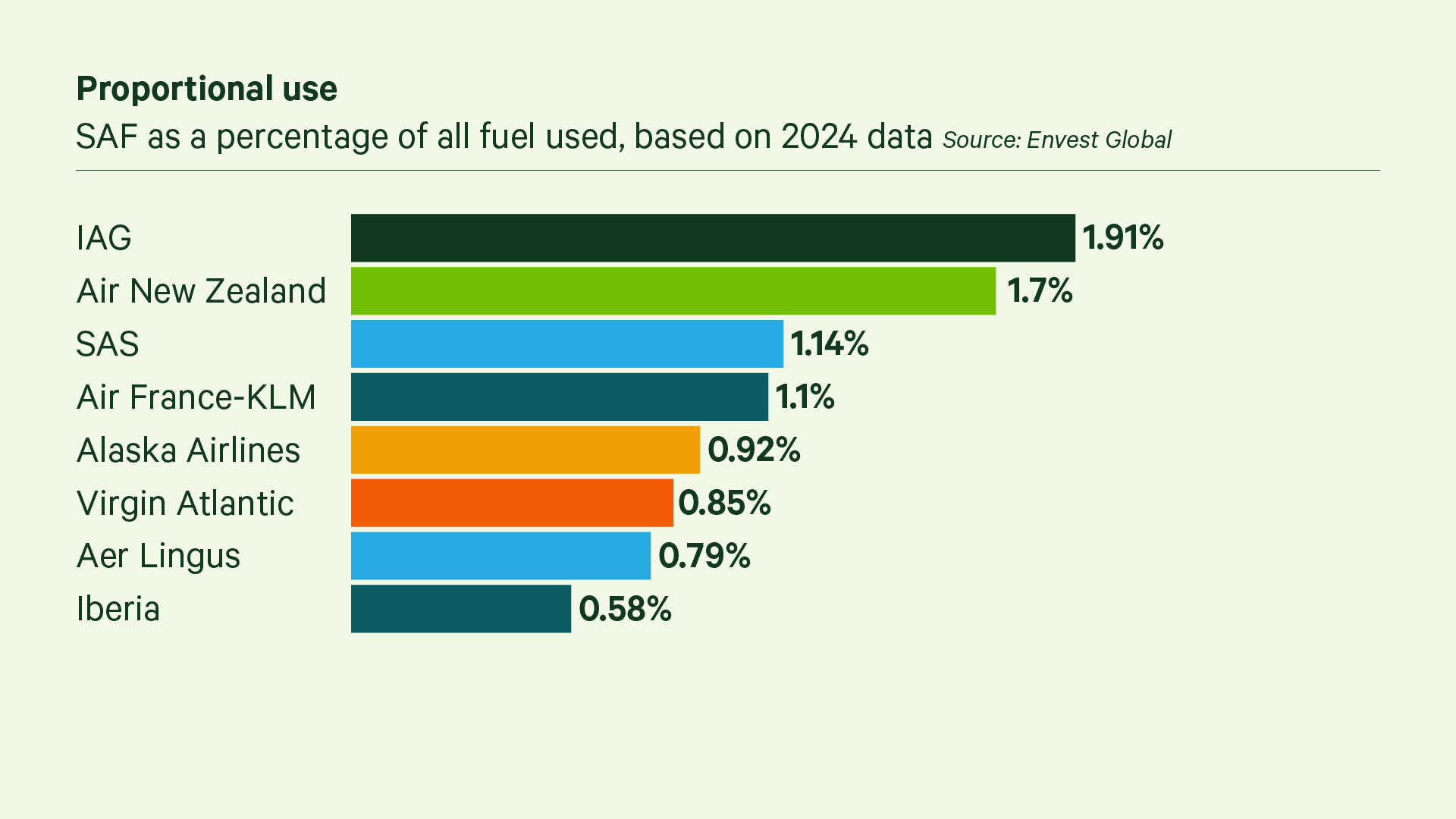
Mandates in the UK and EU require airlines taking off in those areas to use increasingly more SAF, starting at 2 per cent of fuel in 2025, and in the UK, rising to 10 per cent by 2030 and 22 per cent by 2040. The EU's mandate will require airlines taking off from member nations to be powered by at least 6 per cent SAF by 2030 and ultimately by 70 per cent by 2050.
 Source: Envest Global
PASSENGER LOAD FACTORS
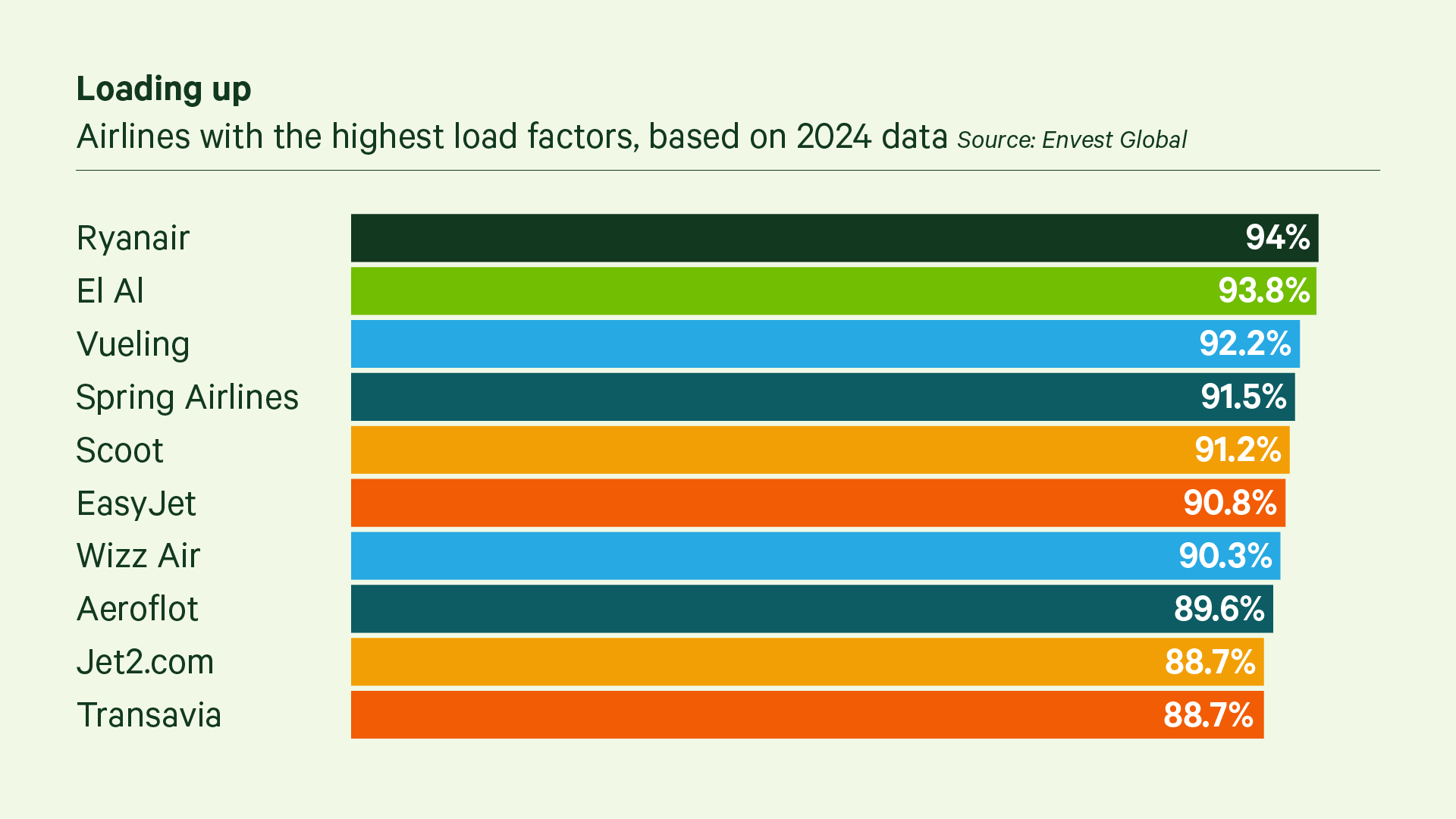
As Envest Global states, the most carbon-efficient airlines typically have the highest passenger load factors. With an average load factor of 86 per cent, low-cost carriers perform almost 6 per cent better than full-service carriers. At 94 per cent, Ryanair is the best at filling its seats.
 Source: Envest Global
AVERAGE FLEET AGE
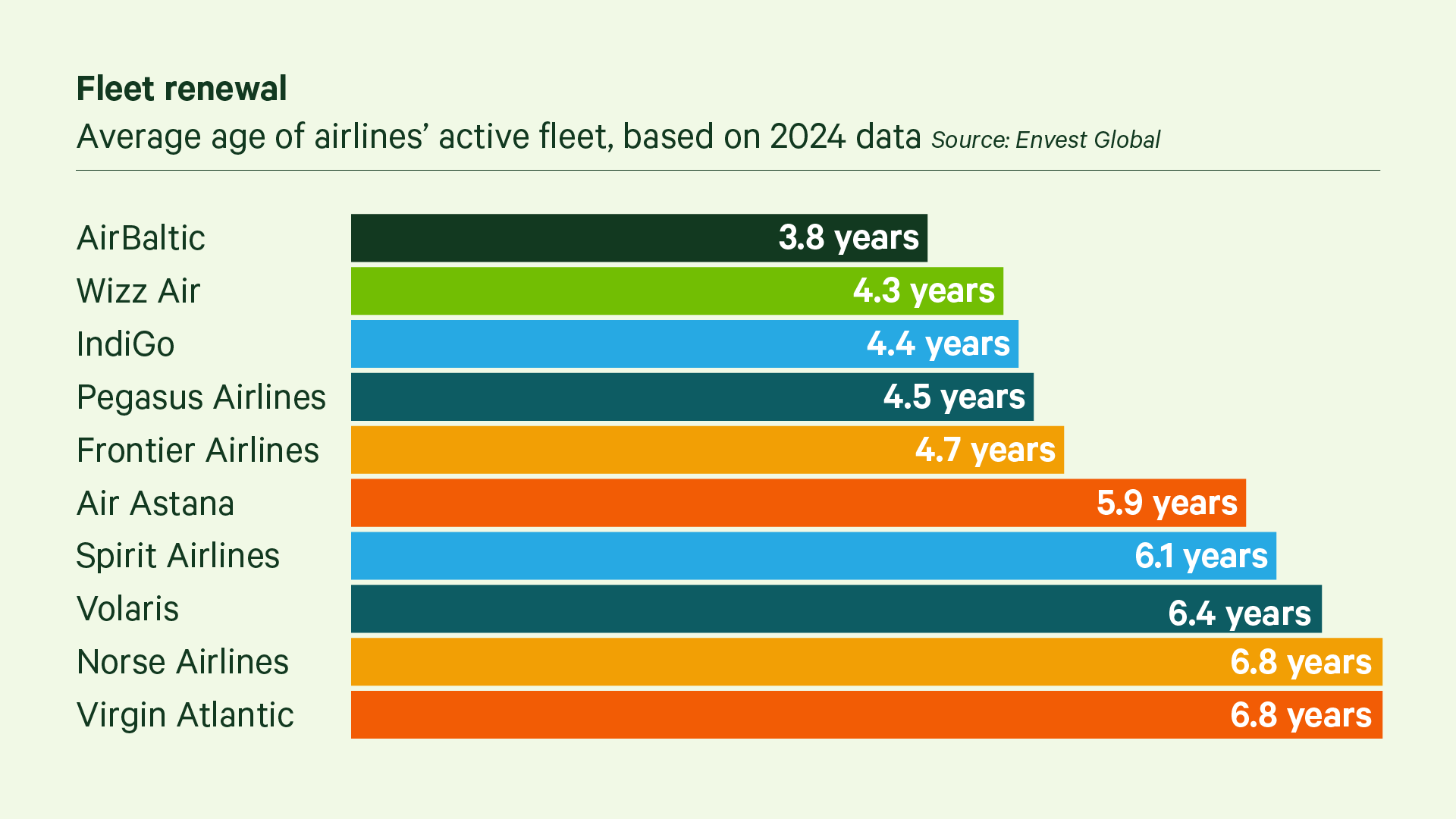
The average age of an airline’s fleet is another fundamental signal of its carbon efficiency, with modern aircraft considerably more fuel efficient than their predecessors. Newer aircraft models are typically 15 to 25 per cent more fuel efficient than the previous generation they replace.
 Source: Envest Global
CORPORATE DISCLOSURE
Paris-based Areka Consulting recently published the findings of its research into how the world’s largest companies report – or do not report – the carbon emissions associated with their business travel activities.
“There is increasing global concern around climate change which is leading to growing expectations for organisations to disclose their environmental impact and their objectives in an open, credible and consistent way,” said the company’s founding partner and CEO Pascal Jungfer.
Speaking on a webinar about the research, Areka consultant Jigyasa Nerchehal added: “Climate disclosure is no longer just a choice for firms, it's a business imperative, and companies must be ready to not just comply with them [regulations], but also to lead by example.”
The consultancy assessed two years’ worth of ESG and sustainability reports from the largest 150 companies in the world – as identified by the Fortune 500 – to explore how extensively companies publicly report the carbon emissions associated with their business travel activity (scope 3.6) and whether plans are in place to reduce them.
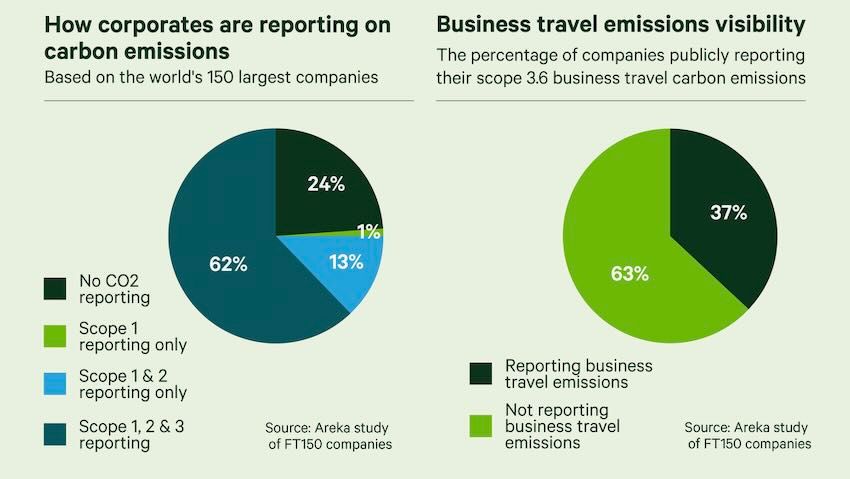
Areka’s research found that although 62 per cent of the companies it investigated publicly report on their scope 1, 2 and 3 emissions, only 37 per cent (55 companies) specifically report their scope 3.6 business travel emissions. It also noted that a range of diverse methodologies are implemented to generate those reports.
 Source: Study conducted by Areka Consulting
Companies in some sectors are more likely to report their business travel emissions than others, the research found, with the technology, media and telecoms sector and the automotive and transportation sector leading the way. Oil and gas companies were the least likely to publicly identify their scope 3.6 emissions, potentially because of their negligible contribution to those organisations’ overall carbon footprint.
The proportion of a company’s overall emissions that corporate travel accounts for is known to vary significantly by business sector, but the average among the 55 companies assessed by Areka – a relatively small sample – was just 0.26 per cent. It pointed out that business travel emissions for professional services providers, which did not feature among the 55 organisations declaring their scope 3.6 data, can be a considerably higher proportion of overall emissions (even as high as 80 per cent in some cases, BTN research has found).
Using its own estimates and data from BTN’s Corporate Travel 100, Areka found that business travel emissions as a percentage of overall emissions (0.26 per cent) corresponded closely with spending on business travel as a percentage of company revenue (0.29 per cent).
Its research also found that 60 per cent of the Fortune 150 have net zero targets – predominantly for 2050 – and 51 per cent have specific scope reduction targets. However, business travel reduction targets are rarely mentioned, Areka found. Where they are publicly noted, travel avoidance was identified as the primary lever for achieving them, followed by lower carbon travel options, use of smart travel tools, investment in SAF, and carbon pricing tools.