Travel managers, particularly those in industries such as consulting and professional services where business travel is sometimes the most significant source of carbon emissions, are increasingly having to become experts in sustainability.
Amid growing pressure to master a range of arts, it’s not surprising that companies are working with a wide range of partners to deliver on sustainable travel expectations.
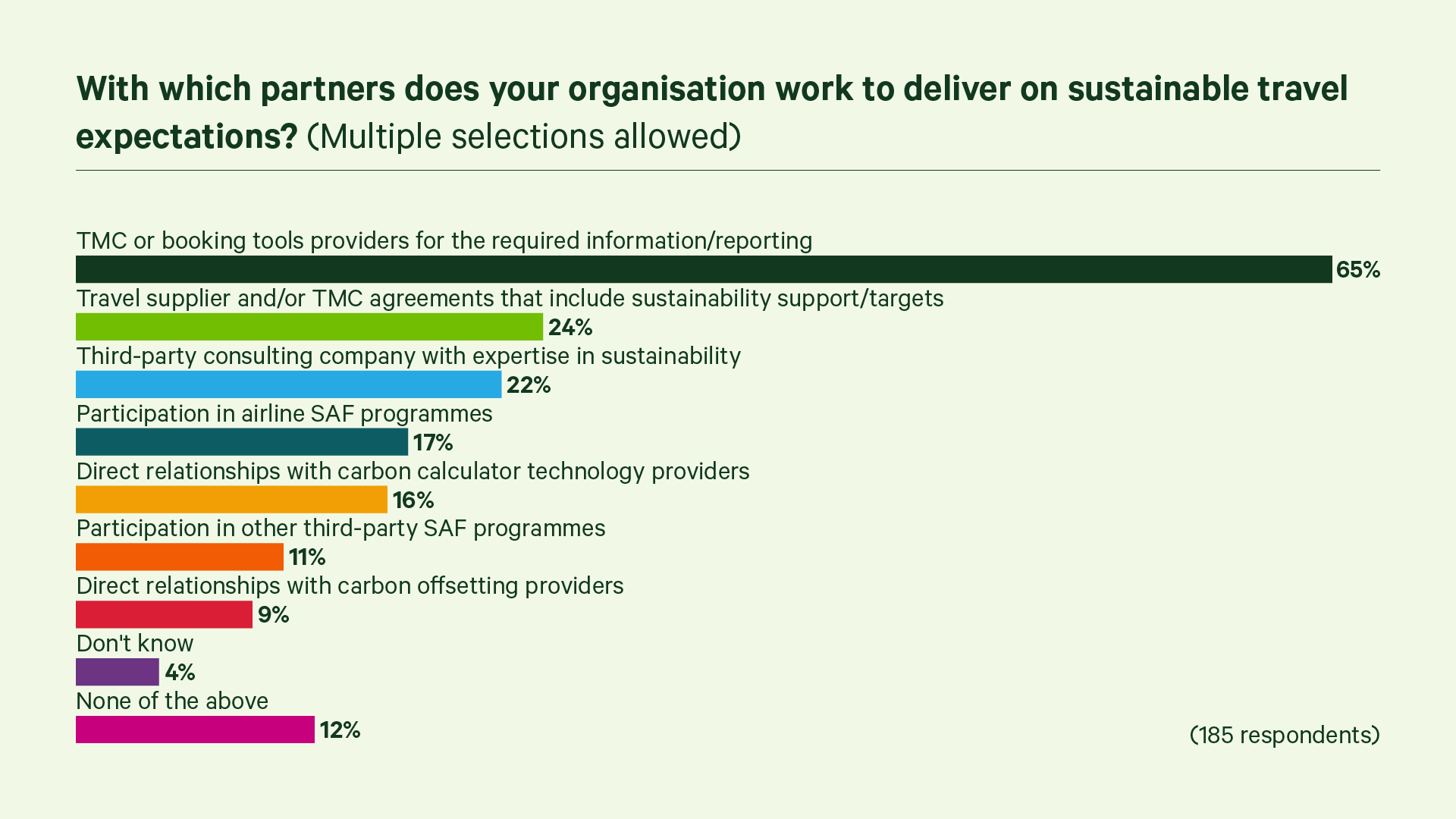
According to BTN’ survey of 198 travel buyers, TMCs and OBTs are the most common partner for this, with 65 per cent of respondents leaning on them for reporting information and other data.
Nearly a quarter of buyers include sustainability support and objectives in supplier and TMC agreements, while 22 per cent are working with third-party consultants with expertise in sustainability.
Seventeen per cent of respondents’ companies participate in airlines’ SAF programmes, 16 per cent have direct relationships with carbon tech providers, 11 per cent utilise third-party SAF programmes, and 9 per cent have direct relationships with carbon offsetting providers.
As transaction fees have dwindled, many TMCs have expanded their consultancy services and sustainability is usually among them.
Pippa Ganderton, director of Halo at ATPI, says: “With smaller teams, travel managers are taking on a lot more, whether that is sustainability or wellbeing. They can't be experts in all of that, so they should be able to rely on a TMC to provide them guidance.”
She adds: “I've been into some clients where you read the public website and it's got a statement saying they want to be carbon neutral, or reach net zero. I often ask ‘do you have a strategy for achieving that with the travel programme?’ It's not uncommon that they don't or haven't been assigned what their trajectory is to reach that for the travel programme.”
Lauren Hook, CTM’s head of sustainability, says: “Great travel managers are adaptable problem-solvers. That skill set is an advantage when it comes to sustainability too. Travel managers don’t need to be subject matter experts, but the ability to coordinate the necessary people in their organisation and ensure they have the information they need will best position them for success.”
LEAVING IT TO THE EXPERTS
Some travel managers prefer to work with specialist sustainability platforms and consultants to bolster their own skills.
Philipp von Lamezan, Squake CEO and co-founder, says, “We believe in a split of competence. We let the front end sit with the experts: OBTs have done this for years and TMCs have been in client relationships and managing the overall programme for decades. As a travel manager, you're the pilot of the plane. Your travel programme consists of the dashboards informing you about how the plane is flying or how the travel programme is performing.
He continues: “Carbon emissions is basically like a new gauge which you have to monitor. Building a new tool which sits outside of the cockpit – the OBT, the TMC, the BI tool – doesn’t really make sense. This is where we divide functions. We say we want to be the best provider [of carbon reporting] but how you arrange the cockpit... that's not up to us.”
While some travel managers are clearly becoming skilled in sustainability, it is sometimes still not enough.
Julien Etchanchu, senior director of sustainability of Advito, says: “The problem is that even if they are experts it doesn’t make any difference if they don’t have strong internal buy-in. The CEO says what it is going to be like and the whole company works in that direction.”
If the boss says they have to travel then it does not matter even if the travel manager is highly trained and knowledgeable about sustainability, he argues. “So it's not so important to be trained in sustainability but it is critical to have a clear strategy not only from the sustainability team but also from the C suite.”
Etchanchu believes that tying sustainability into wider corporate objectives could be the answer in gaining that high-level support.
“Globally, we do not communicate well enough on sustainability,” he says. “When you say you should reduce travel, it's not enough to say it is bad for the environment. Instead you can also tie it in with wellbeing.” He takes as an example a ten-hour flight to India, a six-hour time zone difference, and high pollution as a trip you might think twice about on the grounds of both carbon emissions and personal wellbeing.
ASKING THE RIGHT QUESTIONS
As travel managers are working more closely with providers on sustainability, it is no surprise that sustainability questions are showing up more in RFPs. Garnering information on the sustainability of suppliers and other partners is now a standard part of the tender process.
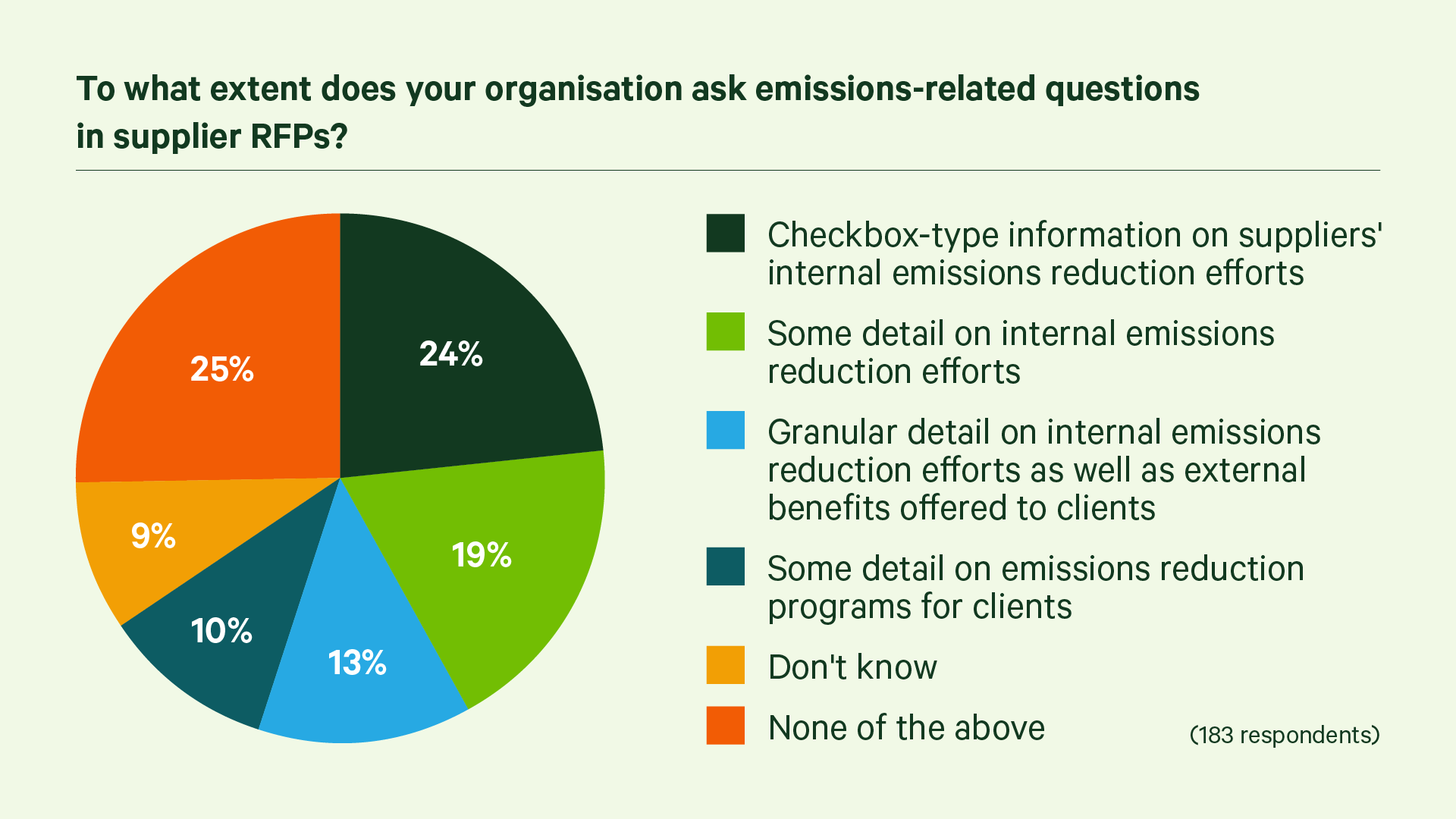
Two-thirds of travel buyers (66 per cent) in our global sustainability survey say their organisation include questions on sustainability in their RFPs.
For just under a quarter of travel buyers (24 per cent) this is simple checkbox information on suppliers’ internal emissions reduction efforts.
Advito’s Etchanchu is dismissive. “It is very ‘yes, no, yes, no’ and you cannot distinguish one supplier from another with that,” he says. “Most questions you see in RFPs... honestly, they don’t help a lot. You want to be very precise with the questions.”
Some travel managers are recognising this. Our survey found that 19 per cent of travel buyers are asking for some additional detail on suppliers’ measures to achieve internal carbon reduction efforts. One in ten (10 per cent) of travel buyers ask for detail on emissions reduction programmes for clients as well.
A small number of organisations (13 per cent) want significantly more detail and ask for granular detail on internal emissions reduction efforts as well as information on external benefits offered to clients.
ACTING ON THE ANSWERS
But where is the data coming from to answer these questions? Advito’s Etchanchu says: “The best reporting is coming from consulting companies like us and Thrust Carbon. It is hard for a TMC to consolidate everything and apply a proper methodology.”
Parexel’s executive director for travel & sustainability, Benjamin Park, says his company is embedding sustainability questions into RFPs and supplier selection, ensuring that emissions data and reduction strategies are part of its procurement process.
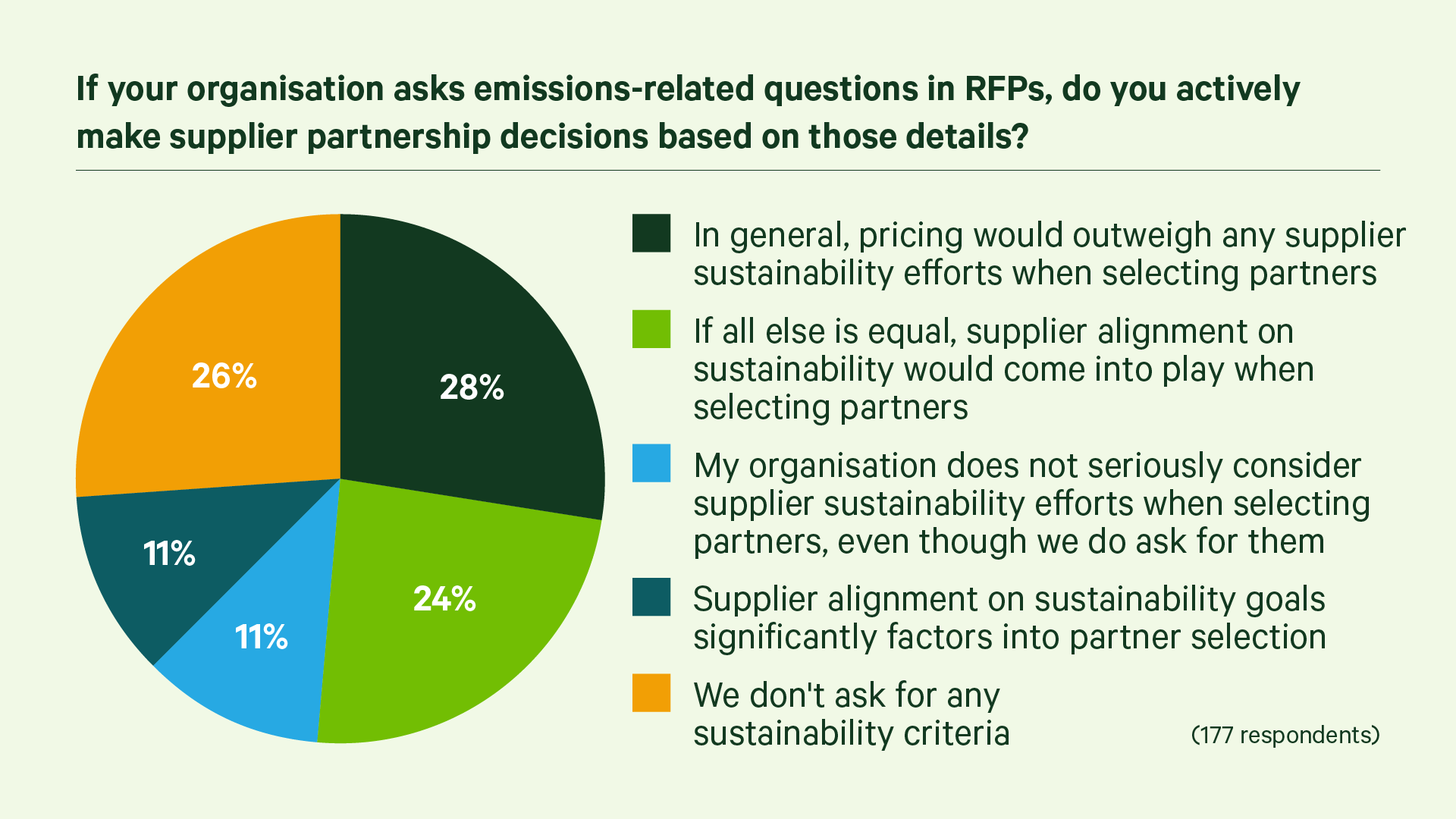
Sustainability criteria are important in the supplier selection process for some organisations. In our survey, one in nine travel buyers (11 per cent) say that supplier alignment on sustainability goals significantly factors into partner selection.
Despite sustainability appearing more often in RFPs and travel buyers working with a range of suppliers and intermediaries on managing it, there is a stark reality – cost is still paramount when it comes to supplier selection. Our research found that 28 per cent of travel buyers say that pricing outweighs supplier sustainability in the selection process and 24 per cent of organisations say that suppliers’ sustainability credentials would only come into play if all else is equal.
HOLDING BACK THE GREEN TIDE
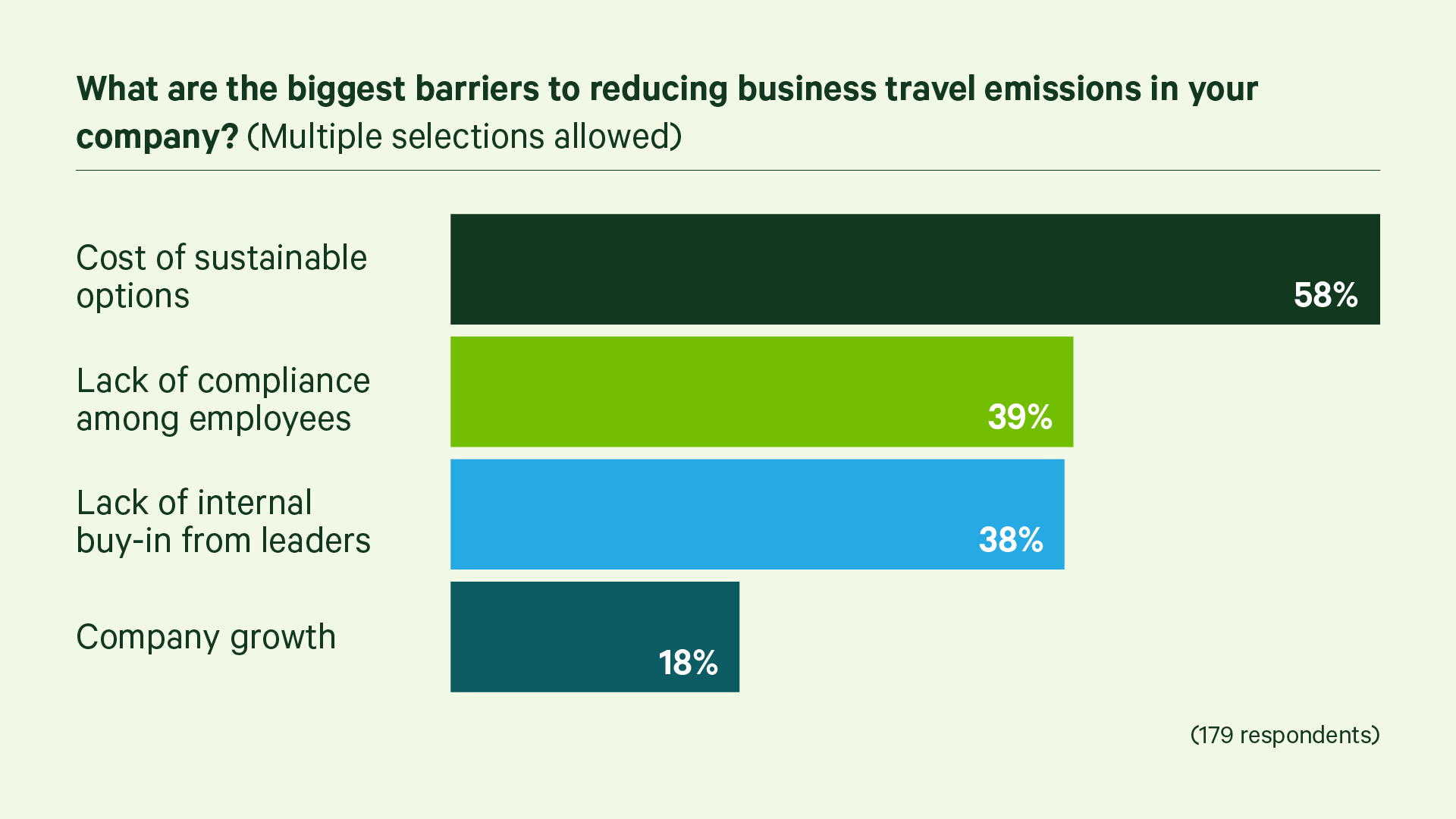
Sustainable business travel is often perceived as coming with a premium. Whether there is truth in that or not can be debated at length, but nearly six out of ten travel buyers (58 per cent) in our survey believe the cost of sustainable options is a barrier to reducing business travel emissions.
Buyers' sustainability efforts are also being stymied from both above and below – 39 per cent of respondents said lack of compliance among employees is a challenge and a similar proportion, 38 per cent, pointed to a lack of internal buy-in from business leaders as holding back sustainability efforts.
NEXT ARTICLE: THE DIFFICULT DECARBONISATION JOURNEY
RETURN TO BTN'S 2025 BUSINESS TRAVEL SUSTAINABILITY REPORT