American Express Global Business Travel projects airfares will continue to rise in 2027, but at "a more modest pace" than in 2026, when fares increased by double-digit percentages "on many routes" year over year, according to the company's Air Monitor 2027, released on Wednesday. Meanwhile, corporate demand is "staying firm," according to the travel management company.
The spikes in jet fuel prices related to the Middle East conflict that helped drive fare hikes in 2026 are expected to lessen next year, according to Amex GBT. But the company does not expect fuel surcharges, which "significantly increased" ticket prices in 2026 and raised round-trip rates on some transatlantic routes by up to £610 (€730, $800), to reduce "materially" in 2027.
"If geopolitical conditions shift and spur another round of fuel-price rises, surcharges could go up, and prices with them," according to the report.
Meanwhile, several carriers are expanding premium cabins and relying more heavily on the use of ancillary charges, helping to keep overall air travel costs rising, according to Amex GBT.
Because of the geopolitical and economic uncertainty in the world, Air Monitor 2027 offers a forecast range for routes and cabins, not just a single projection as in the past. Amex GBT also suggests using the lower range if global inflation stays within the International Monetary Fund's projected 4.1 per cent rate for 2027, and the upper range if it runs higher.
Europe
Amex GBT suggested weak economic growth in Europe in 2027 should help keep intra-European fares "relatively stable".
"You could even see a modest decline in ticket prices in the business-class cabin," according to the report. Airline consolidation, however, could reshape competition in the longer term, it said.
Amex GBT projects intra-European business-class fares will range from a 1.5 per cent decline to a 0.3 per cent increase. Transatlantic business-class fares are forecast to rise 3.4 per cent to 4.3 per cent.
[Report continues below chart.]
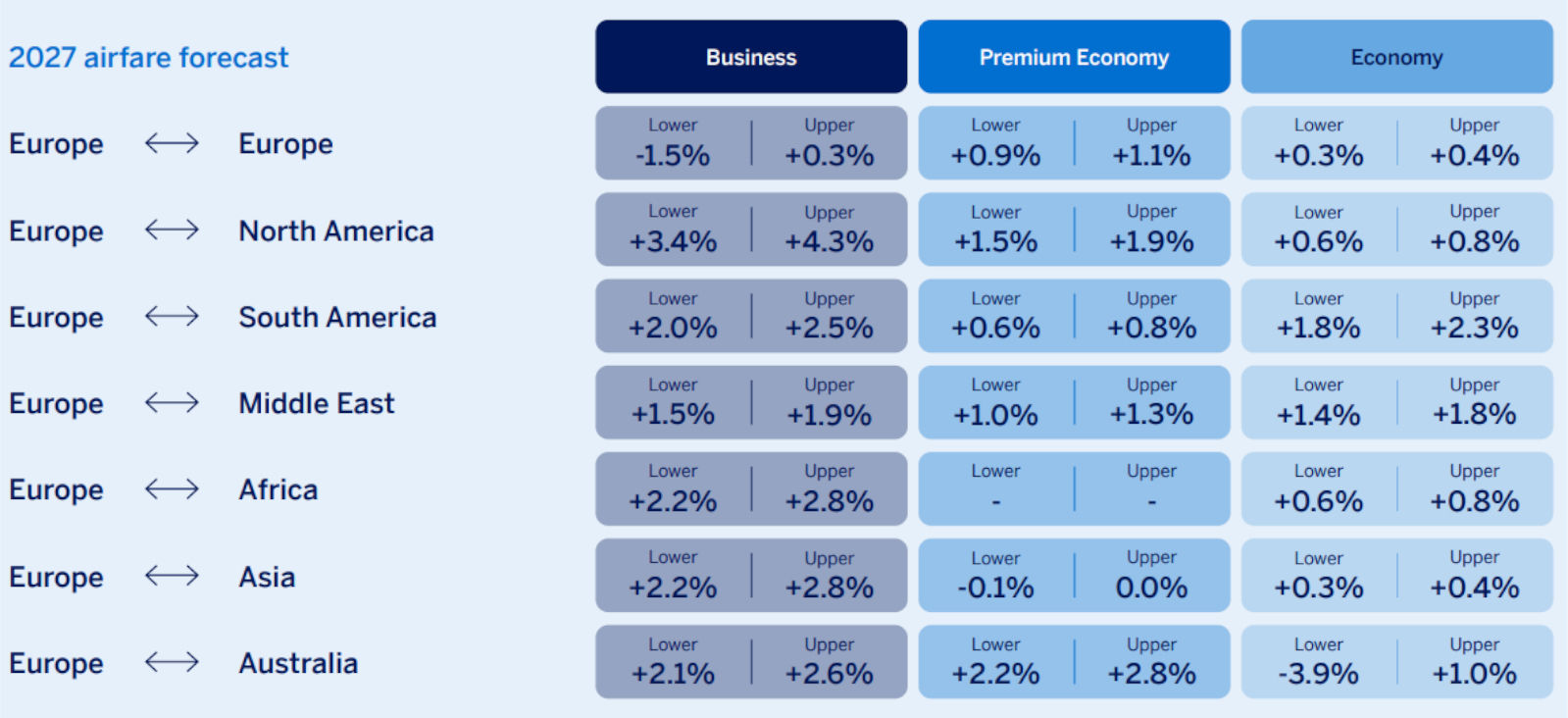 Projected 2027 airfare changes for Europe Credit: Amex GBT
North America
The 2027 airfare forecast for flights within North America projects that business-class fares will increase 2.7 per cent to 3.4 per cent year over year, while premium economy fares will increase 2.1 per cent to 2.6 per cent and economy fares will go up 3.4 per cent to 4.3 per cent.
Delays in aircraft deliveries "could curtail" fleet upgrades and constrain capacity growth, adding to increased fare pressure, according to the report. The closure of Spirit Airlines in May 2026 also could increase fares between the US and Mexico.
South America
Amex GBT for 2027 projects intra-South American fares to increase 1.1 per cent to 1.4 per cent year over year for business, with premium economy fares ranging from a 0.4 per cent decline to a 0.1 per cent increase.
Economy fares, however, are forecast to increase 4.2 per cent to 5.3 per cent due to increased demand from wealthier consumers, increased inbound tourism and a wave of restructuring and consolidations that has strengthened the competitive position of the region's mainline carriers.
Asia-Pacific
For next year, Amex GBT projects intra-Asian airfares to increase 1.4 per cent to 1.8 per cent year over year in business, 1.2 per cent to 1.5 per cent in premium economy and 2.1 per cent to 2.6 per cent for economy.
The projected range for intra-Australia business fares is a decrease of 2 per cent to an increase of 0.5 per cent, while premium economy fares are forecast to remain steady. Economy fares are projected to increase 3.8 per cent to 4.8 per cent.
Middle East and Africa
Intra-African business-class fares are projected to rise 4.5 per cent to 5.6 per cent. Business-class fares between Australia and the Middle East could range from a 7.2 per cent decline to a 1.8 per cent increase as Gulf carriers restore capacity.
Airfare forecasts for Air Monitor 2027 were generated using "multi-grained modelling," which combines aggregated and anonymised Amex GBT transaction data with a range of supply, demand and other economic variables, such as gross domestic product, inflation and seasonality and airline industry metrics, according to the company.