THE 2026 OUTLOOK
The convergence of landscape-shifting moments this year and a race to deploy AI could redraw the contours of travel management in 2026


The events of 2025 have positioned 2026 as a turning point for corporate travel management, with the ripple effects of new partnerships and fast-moving technology beginning to reshape the landscape.
Uncertainty prevails across travel management as we enter 2026, and travel managers will be dealing with it from every conceivable angle. Strategic, financial, technological and geopolitical variables are all in flux, leaving buyers to make long-term decisions in a market that feels anything but settled. With American Express Global Business Travel and CWT finally sealing their long-anticipated union – and in doing so putting considerable daylight between themselves and the rest of the field – many buyers will be reassessing where their programmes are best placed for the years ahead.
That question is complicated further by Amex GBT’s own strategic signalling. The TMC, which continues to explore a potential sale, also inked a partnership with fellow legacy player Concur, even as an increasing number of buyers express interest in newer, more modular platforms built around open ecosystems and plug-and-play functionality. These represent two very different visions of the future. Neither is inherently right or wrong, but the choice now carries greater weight.
Overlaying this is a renewed focus on financial governance. The recent uncovering of financial irregularities at CTM has served as a timely reminder that buyers cannot afford to be passive when it comes to money flows, reconciliation processes and transparency with partners. Scrutiny is rising and tolerance for ambiguity is falling.
Meanwhile, buyers must also cut through the smoke and mirrors of AI-related announcements. Travel management companies and suppliers are undoubtedly deriving real value from AI, both internally and in customer-facing applications. But as “AI-powered” becomes PR shorthand, the ability to distinguish meaningful progress from marketing messaging will be critical.
Perhaps more than anything, the business travel industry is craving a measure of stability in 2026. Uncertainty is nobody’s friend, and the effects of geopolitical tension – compounded by President Trump’s return to the White House last year – were plain to see. Whether 2026 delivers calmer waters remains to be seen, but travel managers should brace for another year where vigilance, adaptability and clear-eyed decision-making are essential.


Revisiting the 2025 Outlook
Looking back at our 2025 Outlook published in December last year, pricing forecasts that predicted moderate rate rises, albeit in a “fragile” environment, were right on the money. But no one could have foreseen the impact that newly-imposed US trade tariffs would have on travel and on business confidence more broadly.
However, GBTA's Catherine Logan correctly pointed to the growing importance of trip value and travelling “smarter”– even if this was driven by cost savings rather than environmental concerns, as Logan had expected. Hopes that 2025 would be “the year of sustainability action in business travel”, as consultant Sally Higgs put it, were somewhat thwarted when the EU put climate regulation, such as the Corporate Sustainability Reporting Directive, on the back burner to focus instead on reducing regulatory red tape and improving the bloc’s “competitiveness”.
A flurry of TMC M&A activity in 2025 – including the completion of American Express Global Business Travel’s $540 million acquisition of rival CWT – proved Take2Eton Group CEO James Parkhouse’s prediction that M&As would multiply. “This is being driven primarily by the need for these TMCs to remain competitive, to navigate the increased complexity in managing travel, to invest in new technology, and to combat increased operational costs,” he said. Further consolidation was also witnessed across the broader supplier landscape, particularly in Europe’s aviation sector. This looks set to continue in 2026.
Other contributors highlighted the potential of generative AI to drive efficiencies in travel management and “revolutionise” trip planning. PredictX CEO Keesup Choe rightly described AI Agents as “the biggest and most exciting development in terms of using AI in business travel”. Amadeus Cytric chief commercial officer Mark Cullen also predicted: “We are coming into a world where travel and expense solutions will execute tasks in the background and interact with users at the right time, in an intelligent way.”
Tripstax CEO Jack Ramsey predicted “material leaps” in improvements to user interfaces and experiences (UI/UX), and in 2025 corporate behemoths like Deloitte and GE Heathcare, in fact, traded legacy TMC partners for tech-savvy new entrants Blockskye and Navan, respectively, in an effort to improve traveller experience.
None of last year's contributions anticipated the extent to which an increasingly volatile geopolitical environment would impact travel management. In addition to trade tariffs, regions of armed conflict and social unrest and an uptick in cyber attacks put travel risk management front and centre in 2025.
Read on to discover what our contributors predict for 2026, followed by key industry price forecasts for the upcoming year.


2026 INDUSTRY PREDICTIONS


BUSINESS AGILITY
Suzanne Neufang, chief executive officer, GBTA
As we look to 2026, business travel will continue to deliver value and ROI alongside its steady growth but the landscape will be more complex than ever. GBTA forecasts global spending to reach $1.69 trillion, an 8.1 per cent year-over-year increase, underscoring our industry’s resilience amid economic uncertainty and regulatory shifts. Agility will be essential as companies navigate evolving supply chains and market dynamics. At the same time, innovation will shape how we travel – and manage travel – for work. AI-powered tools, predictive analytics, and integrated data platforms are transforming travel programmes, enabling smarter sourcing and enhanced traveller experiences. Sustainability and duty of care are now strategic imperatives influencing programme decisions globally. Success in 2026 will hinge on embracing technology, prioritising purposeful travel, and aligning mobility strategies with broader business goals. The industry’s ability to deliver value, adapt and innovate will define its continued growth.


FRAUD ON THE RISE
Keesup Choe, chief executive officer, PredictX
2026 will be the year that companies must address a huge surge in travel expense-related fraud. Modern fraud is getting faster and smarter. Within the travel, meetings and expense category, fraud is often hidden in plain sight as new technologies can bypass outdated systems. The rise of AI-generated fake receipts means forged documents now look incredibly real, easily fooling manual approvers, human auditors and legacy OCR-based automated checks. Invisible digital payments, such as Apple Pay and Google Pay, and peer-to-peer apps create transactions that bypass traditional receipt documentation, forming blind spots for manual audits. The scale of the threat is significant. Globally, employee fraud is estimated to cost businesses about 5 per cent of their total revenue annually, with expense fraud being a common type of asset misappropriation. While AI is facilitating this surge in fraudulent expense claims, next-generation AI will also be the silver bullet to combat the threat. We will see a lot more travel managers adopting AI-driven fraud detection technology over the next 12 months.

ALIGNING AI
Chris Pouney, global T&E process lead
As artificial intelligence reshapes corporate travel, the temptation is to treat it as a universal solution – the proverbial hammer where every challenge looks like a nail. Yet true progress requires more than clever prompts. Companies must first establish strong foundations: cohesive travel policies with executive buy‑in, a capable TMC, and a resilient tech stack. Business travel is becoming more complex, more frequent, and more costly. Buyers need to be lifted out of the weeds, focusing on strategy rather than firefighting. Crucially, AI integration must be aligned with travel management companies and suppliers, ensuring transparency and consistency across booking, reporting, and duty of care. At the same time, buyers should prepare for cultural resistance. Travellers and approvers may be wary of AI‑driven decisions, making change management and clear communication essential. Success in 2026 will come not from chasing every AI trend, but from embedding it into trusted frameworks.

TRAVELLER EXPERIENCE
Adam Kerr, CEO and founder, Tripism
In 2026, the traveller experience will take centre stage. Organisations have recognised that a friction-free travel experience is directly linked to employee wellbeing, productivity, and retention. For travel managers, programmes are being redesigned around the traveller journey with intuitive booking tools, mobile-first support, faster reimbursements, and access to peer feedback. These are critical factors that all contribute to driving seamless, stress-free journeys. Duty of care is also expanding: 24/7 support, mental health, and wellbeing on the road matter as much as safety. Travel is no longer a transaction but an extension of the company’s culture and employee value proposition. As hybrid work reshapes when and why people travel, each trip must feel purposeful, human and friction-free. Forward-thinking organisations recognise that employee connections are vital for better performance and engagement, whether with peers, customers, or partners.

INTEGRATED PARTNERS
Chris Thelen, chairman, Take2Eton Group
TMCs have traditionally built global networks based on similar-sized or type of agency partners in each market. However, we will see a shift in this model, as it no longer aligns with corporate needs. A major issue is the inconsistent technology platforms used by various TMC partners, relying on multiple GDSs and OBTs. The Concur/Amex GBT partnership aims to create a seamless, global user experience, akin to platforms like Apple or Uber. While digital advancements allow this for a mega TMC, we haven’t seen it in partner networks. Corporates need a single lead TMC as the 'face' of the solution, with tightly integrated partners on a unified tech and data platform. These developments in digital solutions will open opportunities for new alliances, better matching customer demand for local expertise delivered through a single, integrated platform – something that wasn’t possible five years ago.

LIVING STANDARDS
Rebecca Hollants Van Loocke, chief operating officer, EMEA, Frasers Hospitality
In 2026, serviced living stands at the intersection of home, work and wellbeing. Extended stays have evolved beyond functional accommodation to become a ‘third space’ where productivity, lifestyle, and authentic experiences converge. Guests now expect flexible, human-centric environments that support work and play through coworking lounges, wellness integration, and curated cultural immersion. Cities across Asia and Europe are emerging as global hubs for workcations and long-stay travel, driven by digitally mobile professions, hybrid work arrangements, and experience-seeking travellers. Sustainability, wellness, and connectivity are now expectations, not differentiators. Value isn’t defined by price, space or amenities, but by quality, local enrichment, and the sense of belonging. Success will hinge on creating agile and immersive environments that empower guests to live, work, and thrive intentionally.

DATA IN DANGER
Scott Wylie, chief technology officer, TripStax
The cyber-crime threat will continue to be omnipresent in 2026 with attacks not only increasing in volume, but also in sophistication as criminals are now using AI to make their attacks harder to detect and combat. Europe experienced the steepest regional growth in attacks in 2025 with a 22 per cent rise year-on-year. And according Google’s latest Cybersecurity Forecast, that trend will continue in 2026, because attackers are exploiting geopolitical tensions, regulatory fragmentation and Europe’s high concentration of highly valuable data. We must be especially vigilant in our industry. The data lakes in business travel are like Aladdin’s cave for hackers – full of rich information, individual names, addresses, credit card and passport numbers. What can travel managers do to keep the hackers at bay? Certainly you can encourage your travellers to adopt better cyber-hygiene practices (take care using public wifi, for example). But more importantly buyers need to scrutinise their suppliers’ security efforts closely, check their cyber-security accreditations and make sure they can keep your data safe.

DEPTH OF EXPERTISE
Andrea Caulfield-Smith, managing director, global business travel, Advantage Travel Partnership
Buyer demand is fuelling a new wave of TMC consolidation as agencies evolve their global footprint, driven not only by scale but by technology and capability. TMCs are seeing this as a necessary response to the changing position of buyers who increasingly seek control and the ability to tailor their programmes. This evolution is pushing organisations to move away from the megas and toward in-market specialists whose data can integrate directly into their in-house systems. As margins tighten, some smaller TMCs may choose to exit the market, further accelerating acquisition activity and strengthening the negotiating power of these consolidated groups. Despite this, independent TMCs are now better positioned than ever to compete and win by offering depth of expertise, personalised service, and local agility to deliver the quality, flexibility, and value that large, centralised programmes often can’t. It’s not about being the biggest anymore; it’s about being the best in each niche and giving clients the confidence that their travel strategy truly fits their unique needs.

CURATED CONTENT
Ben Park, executive director travel & sustainability, Parexel
Business travel in 2026 is defined by travel management company market shifts and a race for direct content control. Corporations demand richer, real-time supplier options with fewer intermediaries, pushing online booking tools to integrate new air and rail application programming interfaces (APIs), hyper-personalisation, and sustainability data at speed. Strategic partnerships between travel management companies, technology providers and suppliers will accelerate innovation, while modular, API-first ecosystems powered by agentic AI will replace legacy models. The winners – whether TMCs, tech platforms, or new entrants – will deliver speed, transparency, and curated content aligned with cost, carbon, and traveller experience priorities. In 2026, content isn’t just king – it’s the battlefield.

UP IN THE AIR
John Grant, chief analyst, OAG
While many airlines are still to finalise their complete programmes for 2026, they will all be hoping that next year is relatively quiet without any major external factors such as the yearly French ATC strike or airport power outages impacting their operations. As always, there will be new routes launched and indeed the return of some very old legacy services such as a Guernsey to London Heathrow service from British Airways for at least as long as the subsidy exists. Ryanair, meanwhile, will double down on its strength in the Italian market with new services to Rome and Milan. For those seeking new long-haul destinations and rich enough to pay the UK’s outrageous APD levels, then St Louis beckons with British Airways and Virgin Atlantic will be opening new services to Seoul Incheon and Phuket – two contrasting markets for the airlines marketers to grapple with. More than anything, the whole aviation sector will be hoping that Santa can finally deliver all the presents needed to overcome the supply chain issues that continue to beset the industry.

BUYERS IN THE DRIVING SEAT
Rich Johnson, head of client solutions, Festive Road
2026 is shaping up to be less about autonomy and more about empowerment. It could be the year travel managers break free from operational overload and reclaim strategic influence. With automation expected to reduce repetitive tasks, managers will gain the bandwidth and tools to design programmes that reflect business priorities. For the first time travel managers have genuine choice – traditional TMC-led models or modular set-ups where the TMC is one component among many. This flexibility will enable tailored ecosystems integrating sustainability, risk intelligence, and dynamic pricing – supported by niche expertise to accelerate results. Scania’s recently recognised award-winning programme is a great example of what’s possible when strategy leads and, in 2026, purposeful travel – guided by ESG and ROI metrics under tightening frameworks like CSRD – is set to gain momentum. 2026 isn’t about technology taking over; it’s about travel managers taking charge of design, purpose, and measurable impact.

SMARTER TRAVEL
Donna Fitzgerald, chief growth officer, Clarity
We foresee an emerging trend in 2026: a decisive shift from reactive cost-cutting to strategic orchestration of business travel. With economic volatility and rising rates continuing to pressure budgets, CFOs and procurement leaders are demanding smarter, more aligned approaches to travel spend. This could mean travel managers increasingly focus on consolidation – ie, travel and meetings – to unlock holistic data, enhance financial reporting, and gain visibility of total trip cost. The goal is no longer just savings, but sustainable value: balancing cost control with traveller satisfaction, compliance, and ESG commitments. We anticipate greater collaboration between travel, finance, and procurement functions, supported by integrated platforms and transparent supplier partnerships. In 2026, strategic clarity, not just cost containment, could be the hallmark of high-performing travel programmes.

OPEN APPROACH
Mark Cullen, chief commercial officer, Amadeus Cytric
Industry consolidation dominated 2025, with mergers and tech partnerships reshaping the US$1.5 trillion business travel sector – and analysts expect more ahead. But consolidation can narrow choice. The year ahead calls for flexibility. In 2026, companies and travellers should resist rigid systems and instead select vendors, routes and policies that fit their needs. Open platforms empower businesses to adapt to evolving priorities and budgets, while enabling travellers to choose options aligned with their preferences. Openness means greater agility, resilience, and importantly, innovation, by allowing businesses to integrate emerging technologies quickly. In a market where one-size-fits-all often fails, giving choice back to users isn’t just good practice – it’s progress. A more agile, human-centered travel ecosystem will help organisations thrive amid uncertainty and ensure travellers and travel managers feel supported every step of the way.

CONSUMER TECH
Christophe Peymirat, head of Uber for Business, EMEA
As we head into 2026, cost reduction and sustainability remain top priorities. Continued digitalisation of the business travel ecosystem will play a key role in meeting these goals. We expect to see further consumerisation of enterprise travel technology, with organisations encouraging employees to use company-approved tools and processes. Ensuring adoption is as easy as possible is crucial. Companies need to offer employees experiences that match the intuitive, app-driven tools that they already use in their personal lives. Greater visibility over travel spend will become even more critical as budgets tighten. Ground transportation remains fragmented, with many organisations struggling to track expenses and manage receipts. Stronger integration between business travel platforms and related technologies, such as expense management systems, gives travel managers access to real-time, accurate data, and enables better decision-making, more effective budget allocation, and a tighter control of costs.

RISK ON THE RISE
Cvete Koneska, global security director, International SOS
Business travel risks will continue growing in 2026 while security and risk management capabilities try to keep pace. Persisting geopolitical uncertainty and the increased speed and convergence of risks will weigh on travel decisions. Our 2026 Risk Outlook report found that almost 60 per cent of respondents report that fast-emerging health and security threats are pushing shorter decision-making deadlines. This can lead to further repercussions such as staff facing higher workloads, impacting mental and physical health. 'Hush trips' also emerged as a risk blind spot, with the survey data showing that less than 25 per cent of businesses monitor for unapproved remote staff travel, and even fewer (17 per cent) are equipped to manage the accompanying medical and security risks. Fighting back effectively in 2026 will depend on how quickly and accurately businesses anticipate, prepare and are able to verify information. Integrated and rapid access to time-sensitive intelligence in tandem with quicker authorisation processes will be essential.

TMC REVENUE RETHINK
Tony O’Connor, managing director, Butler Caroye
For decades, TMCs have received about two-thirds of their income as commissions from suppliers. This has effectively subsidised their fees. But the internet has gradually reduced the airlines’ need for travel agents. NDC, their ace in the pack, is causing a ratchet down in overrides and GDS commissions. After so many years of paying below-true-value for TMC systems and services, travel buyers are understandably averse to paying significantly higher fees. So TMCs find themselves in a vice. Commissions are falling but they can’t increase fees enough. There are things they can do to increase revenue that are less than ethical, such as applying hidden mark-ups and pushing higher fares and rates that carry a commission. The pressure they are under means that there is an increasing risk that our fares and rates are inflated by such hidden practices. The solution is a transparent and balanced arrangement that ensures that the TMC makes a sustainable profit without overcharging for travel. I think that 2026 will be the year when travel buyers start to embrace frank, open-ledger discussions with TMCs and booking platforms. Only by offering adequate fees in return for systems and services of real value can we reach mutually beneficial territory.

DEMONSTRATING VALUE
Christoph Carnier, president, VDR
Costs, sustainability and digitalisation will continue to be the key topics in travel and mobility management. The new thing will be how we do it, not what we do. The real challenge is to connect these topics in a smart way. This is precisely what makes the role of travel managers more demanding and complex, and therefore even more valuable to the companies they work for. Although travel and mobility management is not often regarded as a formal core process, without effective mobility frameworks, numerous elements of a business come to a grinding halt. When these processes run smoothly and efficiently, they benefit entire organisations, often without receiving any visible recognition. In 2026, AI will be of assistance, having progressed from an add-on to an everyday tool. The greatest progress will come in areas that remain complex and time-consuming, such as visa processes, compliance checks and reporting. This will create space for what will increasingly define travel managers: not just organising, but also strategically shaping mobility. If I had to name one priority for 2026, it would be to strengthen the strategic value of travel managers through reliable data, clear competencies and meaningful collaboration.

RAIL STEAMS AHEAD
Michael Riegel, CEO, EMEA, Navan
In-person collaboration is back at the centre of how companies drive performance, and corporate travel is rising fast: it was up 20 per cent year-on-year in Q3. But to sustain that momentum into 2026, the journey itself needs to work harder. For shorter hops, rail is winning converts. Lower emissions, the ease of working on the move, and the simplicity of stepping straight into the city centre are outweighing the speed advantage of flying on some routes. By our estimate, London to Paris was the world’s busiest corporate rail route in 2025, cementing its status as Europe’s travelling boardroom. The share of business travellers making this trip by train instead of plane also increased by four percentage points year-over-year, with 83 per cent of London to Paris trips taken by rail compared to 79 per cent over the same period in 2024. Virgin’s move to challenge Eurostar across the Channel will keep attention on this important route into 2026. A more competitive market should sharpen pricing and raise service standards, as operators compete for bookings and loyalty. Rail is certainly one to watch in 2026.

TRAVELLER SUPPORT
Keith Watson, president, Roomex
Wellbeing is set to play a much bigger role in business travel in 2026, largely because there’s now a better understanding of what regular travel actually feels like for the people doing it. Many mobile workers spend long stretches away from home, deal with unpredictable schedules and often end up covering costs upfront. When you add in late changes, inconsistent places to stay and very little time to properly switch off, it becomes clear why travel can take its toll. Next year will see more employers recognising that wellbeing isn’t about adding extras, but about easing the everyday pressure. Clearer information, more predictable routines, appropriate accommodation and simple steps to avoid people being out of pocket all make a genuine difference. These improvements are small on their own, but together they create a travel experience that feels fairer and more manageable. In 2026, supporting travellers will be seen as supporting the workforce as a whole.


STATESIDE CONSIDERATIONS
Martin Klima, chief operating officer, SilverDoor
The recent increase to H-1B visa fees could lead to more offshoring talent out of the US as it impacts both the US and wider global employment landscapes in the year ahead. It has been estimated that more than 70 per cent of H-1B visas went to Indian nationals moving into the US for tech, education and medical roles in particular. The price hike is expected to accelerate migration out of the States which might see more companies offshoring operations to India instead of bringing that talent into the US. In terms of talent and travel management, buyers will have to more closely weigh up the value of an international move into the US, and be prepared for the potential knock-on impact on other visa application processes as there will be increased focus and pressure on employers and corporates to ensure they are fully compliant with the new regulations.

MODERATE CHANGE
Sara Andell, director of consulting strategy, American Express Global Business Travel
2026 is shaping up to be the year of cost moderation. Our latest data from our air, hotel and ground transportation forecasts point to a clear trend: prices are stabilising as we head into the new year. Global air fares are expected to remain flat or rise only moderately, with European business class fares projected to increase by 4.8 per cent and economy by 3.4 per cent as steady demand is met by expanding capacity. The same is true of car rental prices. Hotel rates are projected to follow a similar trajectory supported by significant new supply. That said, value will still vary significantly by corridor, with prices in certain cities like London and Belgium forecast to rise faster than others. The most effective travel programmes in 2026 will focus on routes where supply is increasing and costs are easing, as well as unlocking savings through smarter deals across all services. You want to ensure that your suppliers recognise the total value you bring to their business.
2026 PRICING FORECASTS
GLOBAL SPEND
Global spending on business travel is expected to reach $1.69 trillion in 2026, up from $1.57 trillion in 2025 and from $1.47 trillion in 2024, according to the Global Business Travel Association. In Europe, business travel spend is projected to reach $448.2 billion in 2026, up 8.2% from 2025, and $476.5 billion in 2027. “The data confirms for Europe what many in the industry are experiencing firsthand ─ organisations are continuing to invest in business travel as a catalyst for growth, innovation and connection, even in the face of economic and geopolitical uncertainty,” says Suzanne Neufang, CEO of the Global Business Travel Association.


PRICE STABILISATION
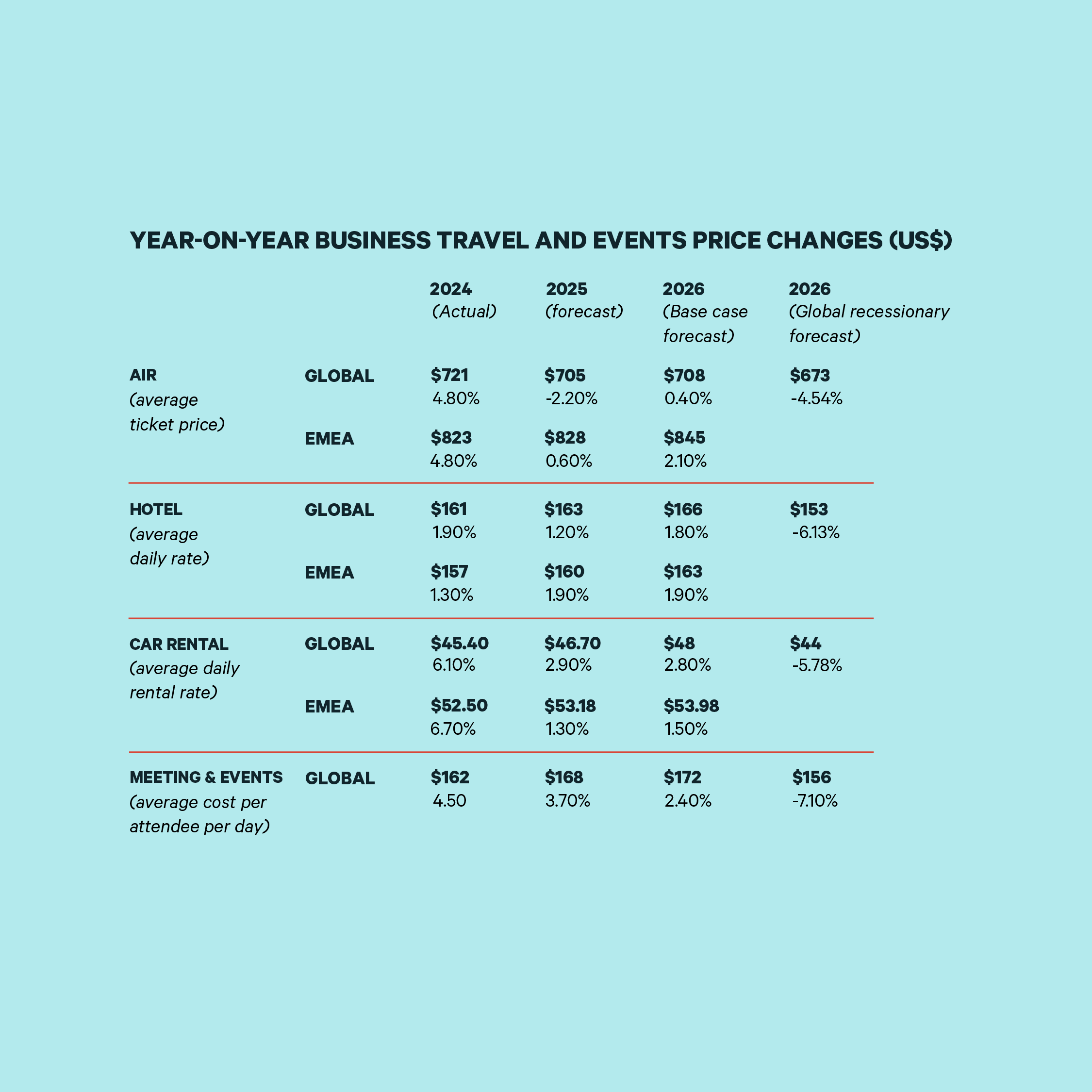
Travel costs are set to stabilise in 2026, according to GBTA and CWT’s Global Business Travel Forecast. The report projects “modest annual fluctuations” in airfares, hotel rates and ground transportation costs, reflecting “more balanced supply-demand dynamics and tempered macroeconomic growth”. Notably, however, the organisations’ forecast includes two scenarios: a base case forecast, which assumes business-as-usual in a weaker but stable global economy, and a global recessionary forecast, which outlines potential price shifts in the event of an economic downturn.

AIR TRAVEL
+0.4% / $708
The average ticket price globally is projected to rise just 0.4%, to $708, in 2026, with fares influenced by a “tug-of-war between constrained seat supply, still-solid passenger demand, and cost base that is easing but remains volatile,” according to GBTA and CWT. Research from BCD Travel puts the average ticket price rise slightly higher, at 1.1%, in 2026. It projects a 2.2% increase in intercontinental business fares and a 2.4% increase in intercontinental economy fares.


HOTELS
+1.8% / $166
The average hotel rate globally is expected to climb 1.8% to $166 in 2026. While occupancy rates remain high globally, new hotel openings continue to lag due to high building costs and more cautious lending, note GBTA and CWT. “As a result, supply growth is likely to stay below historical averages, supporting higher room rates even as demand normalises,” notes the report. BCD Travel’s research, however, projects average daily rate rises of 4.9% in 2026, with increases at their sharpest in the Middle East (8.2%), Latin America (6.4%) and Europe (5.4%).


GROUND TRANSPORTATION
+2.8% / $48
In 2026, the average daily car rental rate is expected to rise 2.8%, to $48, as prices stabilise into a “higher but more predictable range” with “vehicle supply now better aligned with demand”. Robust competition is also helping to keep a lid on prices, according to the 2026 Global Business Travel Forecast. Average rates in Europe are expected to rise 1.5% in 2026, to $53.98.


MEETINGS & EVENTS
+2.4% / $172
The average cost per attendee per day for meetings and events is projected to climb 2.4% to $172 in 2026, with the rate of growth slowing from 3.7% in 2025 and 4.5% in 2024. The 2026 Global Business Travel Forecast notes that elevated expectations around venue quality, sustainability and wellness, as well as ongoing supply constraints in desirable event spaces and locations, are putting upward pressure on event costs.


THE RISK OUTLOOK
Ongoing geopolitical tensions, trade disruptions and cyber-crime are among the biggest risk factors for business travel in 2026, according to the Risk Outlook report by travel risk management company International SOS. The report warns that organisations are ill equipped to handle the increased pace of disruption in a world where “volatility is no longer the exception – it is the operating environment”. In a survey of 860 health, security and risk professionals across 94 countries, 57 per cent of respondents agreed new risks are emerging faster than their companies can deal with them. Geopolitical tensions are by far the biggest driver of uncertainty moving into 2026, as voted by 47 per cent of respondents. Cyber-crime is another concern (27 per cent), followed by political instability (26 per cent), trade disruption (26 per cent) and regulatory uncertainty (24 per cent).